On a June morning in 1859, an American farmer named Lyman Cutlar stepped out to find a large black pig rooting through his potato garden on San Juan Island. He had warned the pig’s owner before. This time, he shot it. The pig belonged to the Hudson’s Bay Company. And with that single shot, Cutlar set in motion an international crisis that would bring the United States and Britain to the edge of war.
The Real Dispute
The pig was the spark, but the powder had been laid years earlier. The Oregon Treaty of 1846 had established the 49th parallel as the boundary between American and British territory, but the treaty language was ambiguous when it came to the San Juan Islands. Both nations believed the archipelago was rightfully theirs, and both had established a presence there, American farmers and British Hudson’s Bay Company operations living in uneasy proximity.
When Cutlar shot the pig, British authorities threatened to arrest him. American settlers appealed to Brigadier General William Harney, who responded by dispatching Captain George Pickett, the same officer who would later lead the disastrous Confederate charge at Gettysburg, with 64 soldiers to establish an American military presence.
The Standoff
Britain responded swiftly. Rear Admiral Robert Lambert Baynes arrived with five warships carrying 2,140 men and 70 guns, vastly outnumbering the American force. For a tense period, war seemed genuinely possible.
But Baynes refused to attack. In one of history’s more quotable acts of restraint, he reportedly stated he would not embroil two great nations in a war over a squabble about a pig. The crisis was referred to Washington and London, where cooler heads prevailed.
Thirteen Years of Peaceful Occupation
In August 1859, both nations agreed to a joint military occupation while diplomats sorted out the boundary question. American soldiers established American Camp on the island’s southern prairie. British Royal Marines set up English Camp in a sheltered cove to the north. And there they stayed, for thirteen years.
What followed was one of the stranger episodes in military history. Officially in a state of armed standoff, the two garrisons quickly became neighbors. They shared resources during harsh winters, held joint athletic competitions, and gathered at each other’s camps for holidays. Officers dined together. Enlisted men played cricket and baseball on the same field. The British maintained their tradition of formal gardens and afternoon tea; the Americans brought their frontier informality.
It was, by most accounts, an entirely pleasant military occupation, the kind that only becomes possible when both sides recognize that the actual dispute is absurd.
Resolution
In 1871, Britain and the United States agreed to submit the boundary question to international arbitration, naming Kaiser Wilhelm I of Germany as arbitrator. In October 1872, he ruled in favor of the United States, placing the San Juan Islands firmly on the American side of the line. The British withdrew their garrison in November 1872, leaving behind their tidy camp, a formal garden, and a cemetery.
The only casualty of the Pig War was the pig.
What You Can See Today
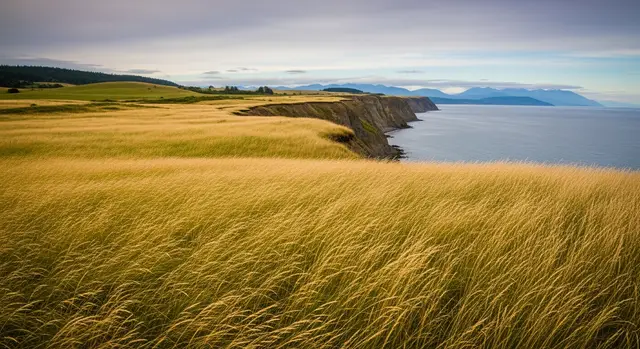
San Juan Island National Historical Park preserves both camps. English Camp, at the north end of the island, retains its formal character, a restored blockhouse, barracks, a cemetery, and a garden that is still maintained today. American Camp on the southern prairie offers sweeping views across the Strait of Juan de Fuca and remnants of the American fortifications.
Together, the two sites stand as a monument to a principle: that international disputes can be resolved through negotiation rather than violence. The Pig War set an early precedent for international arbitration and is frequently cited as a model of peaceful conflict resolution, an outcome far more lasting than any war could have produced.