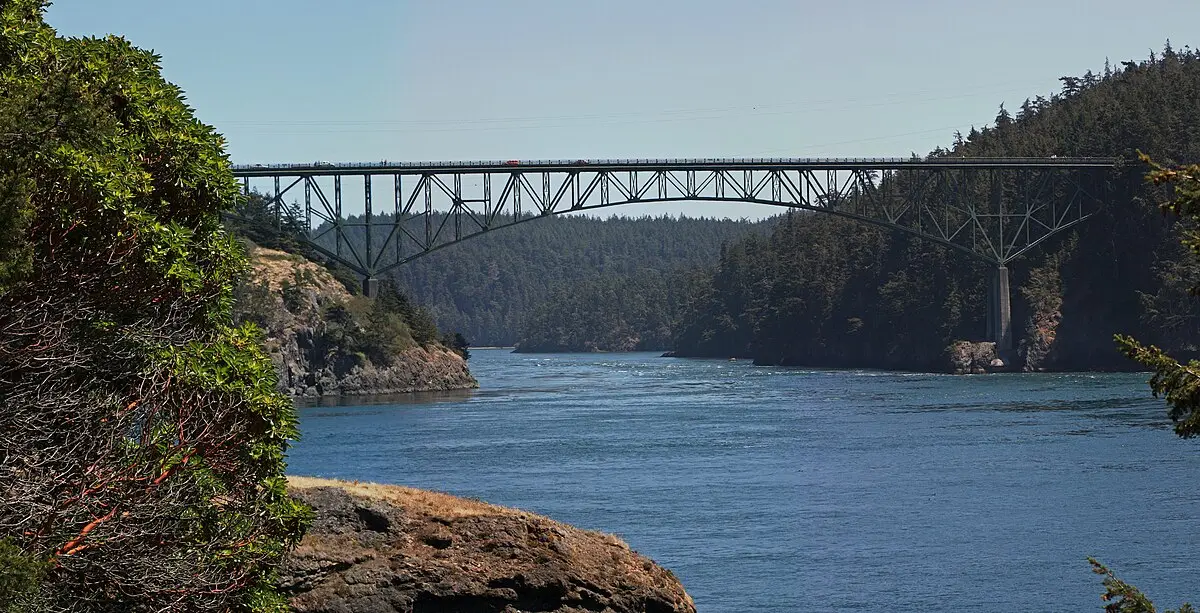
Soaring 180 feet above the churning waters of Deception Pass, this graceful steel cantilever bridge represents one of the Pacific Northwest’s greatest engineering achievements and evidence of New Deal-era determination to connect communities through ambitious public works projects. Since 1935, this iconic structure has safely carried millions of travelers over waters that once claimed ships and challenged even the most experienced mariners.
The Pass That Deceived
Deception Pass earned its name in 1792 when the narrow, easily overlooked passage initially deceived British explorer Captain George Vancouver’s expedition into believing Whidbey Island was a peninsula. Only after careful navigation did the explorers realize the apparent peninsula was in fact an island, separated by a treacherous passage connecting Rosario Strait with Skagit Bay, featuring swift tidal currents, submerged rocks, and unpredictable weather patterns that could trap unwary vessels.
For over a century, these dangerous waters separated the communities of Whidbey and Fidalgo Islands. Residents relied on small boats and ferries to cross the passage, a journey that could take hours in rough weather and proved impossible during winter storms. The isolation stunted economic development and made emergency services nearly impossible to coordinate between the islands.
Coast Salish peoples had navigated these waters for millennia, understanding the complex tidal patterns and seasonal conditions that made safe passage possible. Their knowledge proved invaluable to early European explorers and American settlers, though the passage remained challenging even for experienced Native navigators during severe weather.
New Deal Engineering Marvel
The Great Depression brought unexpected opportunity to the Pacific Northwest through President Franklin Roosevelt’s New Deal programs. The federal Public Works Administration (PWA) provided funding that made the long-sought crossing possible, and the Puget Construction Company was contracted to build the bridge. The nearby Civilian Conservation Corps (CCC), established to provide employment for young men while undertaking conservation and infrastructure projects, built park facilities and approaches in the surrounding area rather than the bridge itself.
Construction began in 1934 under the direction of skilled engineers who had to overcome extraordinary challenges. The bridge required two spans: a 511-foot steel arch over Canoe Pass connecting Fidalgo Island to Pass Island, and a 976-foot cantilever truss over Deception Pass connecting Pass Island to Whidbey Island. The complex engineering required precise calculations to account for strong tidal currents, high winds, and seismic activity.
Workers transported materials by barge through the very waters the bridge would span. The construction employed innovative techniques for the era, including the use of reinforced concrete foundations anchored deep into bedrock beneath the passage. Work continued year-round, with crews battling winter storms and fog that often reduced visibility to mere feet.
Symbol of Connection and Progress
When the Deception Pass Bridge officially opened on July 31, 1935, approximately 700 cars crossed on the first day, a remarkable number for rural Washington in the 1930s. The bridge immediately transformed life for island residents, reducing the journey between Whidbey and Fidalgo Islands from hours to minutes and opening new possibilities for commerce, education, and emergency services.
The bridge’s completion marked a turning point in Pacific Northwest development, demonstrating that innovative engineering could overcome even the most challenging natural obstacles. Its graceful steel arches and soaring towers became an iconic symbol of the region, featured in countless photographs and paintings that captured its dramatic setting above the turbulent waters.
During World War II, the bridge gained strategic importance as a crucial link in coastal defense networks. Military convoys regularly crossed the span while traveling between naval installations, and the bridge itself was occasionally guarded against potential sabotage. The structure’s robust engineering proved its worth during wartime when reliable transportation became essential for national security.
Modern Icon and Gateway
Today, over 20,000 vehicles cross Deception Pass Bridge daily, making it one of Washington State’s most heavily traveled rural bridges. The structure has undergone careful maintenance and periodic renovations to preserve its historic character while meeting modern safety standards. Scenic viewpoints at both ends allow visitors to appreciate both the engineering achievement and the natural beauty of the surrounding landscape.
The bridge serves as the gateway to Deception Pass State Park, one of Washington’s most popular destinations for hiking, camping, and scenic viewing. The combination of natural splendor and human engineering creates a unique experience where visitors can appreciate both the challenges early travelers faced and the ingenuity that overcame them.
Deception Pass Bridge stands as a monument to Depression-era resilience and the power of public investment in infrastructure. Its story illustrates how bold engineering projects can connect communities, stimulate economic development, and create lasting symbols of human achievement that inspire future generations.