1851: A Deep-Water Harbor at the Edge of the World
When Lieutenant Charles Wilkes surveyed Puget Sound for the U.S. Navy in 1841, he noted a deep-water harbor at the northeastern tip of the Olympic Peninsula, where the Strait of Juan de Fuca met Admiralty Inlet.
The harbor itself had been named in 1792 by Captain George Vancouver, who called it Port Townshend after George Townshend, the Marquess Townshend, a British Army officer and field marshal. A decade after Wilkes’s survey, in 1851, settlers arrived and founded the town of Port Townsend on its shore.
The location was perfect: sheltered waters, a natural deep-water port, proximity to the Pacific Ocean, and a customs gateway for all ships entering Puget Sound. Port Townsend became Washington Territory’s official Port of Entry in 1854.
For the next 30 years, Port Townsend grew steadily as a maritime town: shipbuilding, fishing, lumber mills, customs house, saloons, and brothels serving sailors from around the world.
But in the 1880s, everything changed.
The 1880s: Betting on the Railroad
In the mid-1880s, rumors spread that a transcontinental railroad would terminate at Port Townsend, connecting to Portland, Oregon, and linking Puget Sound to the rest of America.
Investors believed Port Townsend would become the “New York of the West Coast.”
Property values soared. Speculators poured money into the town. Population exploded from under 1,000 to over 7,000 in just a few years. Builders constructed a city designed for 20,000 residents, a population Port Townsend has never reached.
Building a Victorian Metropolis
From 1885 to 1890, Port Townsend transformed into a Victorian boomtown:
Uptown on the Bluff: Wealthy merchants and speculators built grand Victorian mansions with Queen Anne, Italianate, and Gothic Revival architecture. These homes had stained glass, ornate woodwork, widow’s walks, and gardens overlooking the harbor.
Downtown on Water Street: Businessmen constructed stone-and-brick commercial buildings in Second Empire, Romanesque Revival, and Italianate styles. Water Street became a bustling commercial district with:
- Hotels for railroad executives
- Banks to finance development
- Saloons (more per capita than nearly any town in Washington)
- Gambling halls
- Chandleries, ship provisioners, and customs brokers
Public Buildings: The town built a Jefferson County Courthouse with a 125-foot Romanesque bell tower, a Federal Building (now the post office), theaters, lodges, and schools.
The Underside: Saloons and Shanghaiing
Water Street had a reputation. It was rough, dangerous, and lawless.
Saloons outnumbered every other type of business. Gambling dens operated openly. Shanghaiing, kidnapping men to serve as sailors on departing ships, was common. Victims were drugged, dragged through underground tunnels connecting bars to the waterfront, and sold to ship captains desperate for crew.
One popular (though possibly apocryphal) story claims that trapdoors beneath saloon floors led to tunnels where unconscious victims could be dropped and hauled to waiting ships.
Port Townsend was a frontier town with Victorian pretensions: elegant mansions on the bluff, vice and crime on the waterfront.
1890: The Railroad That Never Came
In 1890, the dream died.
The railroad venture went bankrupt. The Northern Pacific Railroad chose to terminate on the east side of Puget Sound, Seattle and Tacoma, not Port Townsend.
Then the national economic depression of the early 1890s hit.
Property values collapsed. Investors fled. Population plummeted from 7,000 to around 2,000 within a few years.
Buildings that had been built for a city of 20,000 stood empty. Victorian mansions were abandoned. Water Street businesses closed.
For the next 100 years, Port Townsend stagnated.
Accidental Preservation: Why the Architecture Survived
The economic collapse had an unexpected consequence: the Victorian buildings were never torn down.
In other Puget Sound towns, Seattle, Tacoma, Everett, economic growth meant demolition. Old buildings were replaced with modern ones. Victorian architecture disappeared.
But Port Townsend had no money for new construction. The 1880s buildings remained because there was no reason to replace them.
By the 1960s and 1970s, historians realized what had happened: Port Townsend had become a perfectly preserved Victorian seaport, one of the finest intact examples of a late 19th-century port town on the West Coast.
In 1976, the downtown and uptown districts were added to the National Register of Historic Places.
In 1977, Port Townsend was designated a National Historic Landmark, recognized as one of the finest preserved Victorian seaports in the United States.
The Architecture: A Walking Tour Through the 1880s
Today, 70+ preserved Victorian buildings line Water Street and the uptown bluff.
Downtown Water Street (Commercial District)
Hastings Building (c. 1885): Stone scrollwork and iron vines, ornate metal tiling, pure Victorian excess.
Elks Lodge: Now the Silverwater Cafe, this building once hosted fraternal gatherings and dances.
Rose Theatre: Historic theater still showing films and live performances.
Waterman & Katz Building (1885): Now houses Northwind Art, a gallery showcasing Pacific Northwest artists.
Federal Building: Romanesque Revival post office still in operation.
Uptown Bluff (Residential District)
Elegant Victorian mansions, many converted to bed-and-breakfast inns:
- Queen Anne-style homes with turrets, wraparound porches, and gingerbread trim
- Italianate villas with bracketed eaves and arched windows
- Gothic Revival cottages with steep gables and pointed arch windows
Jefferson County Courthouse
The crown jewel: a Romanesque Revival courthouse with a 125-foot bell tower visible from miles away. It still serves as the county seat.
The 20th Century: Fort Worden and Military History
While Port Townsend’s commercial boom ended in 1890, the town found new life as a military installation.
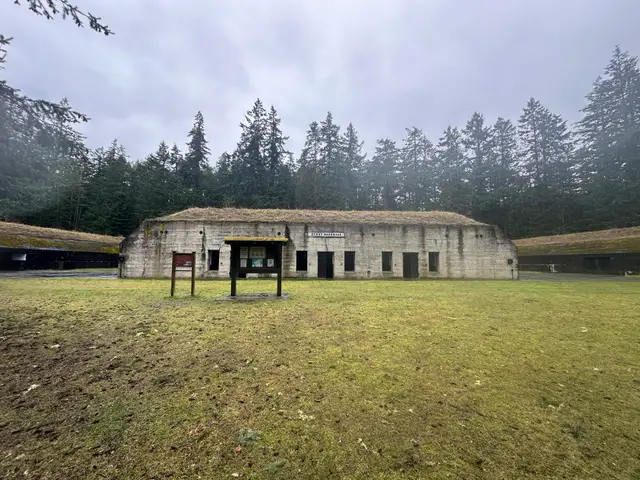
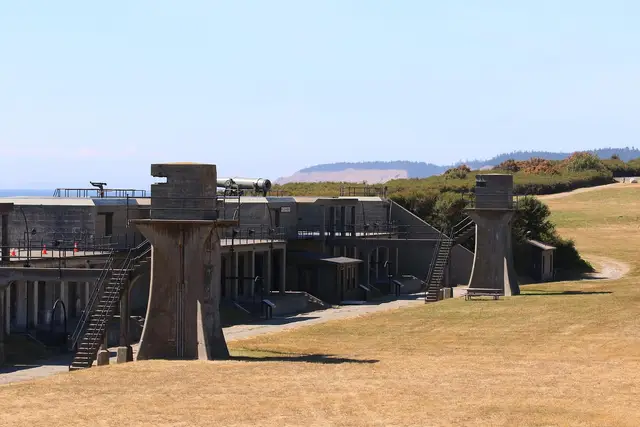
In the 1890s, the U.S. Army built Fort Worden as part of the “Triangle of Fire” coastal defense system (with Fort Casey and Fort Flagler) protecting Puget Sound.
Fort Worden brought soldiers, payrolls, and economic stability to Port Townsend through two World Wars and the Cold War. The fort was decommissioned in the 1970s and is now a state park, hosting arts festivals, retreats, and conferences.
Port Townsend Today: Victorian Seaport and Arts Community
Since the 1970s, Port Townsend has reinvented itself as a heritage tourism and arts destination.
Tourism and Culture
Victorian Seaport Tourism: Self-guided walking tours of historic buildings, museums, and architecture photography.
Arts Community: Monthly Art Walk, artist collectives, galleries, Northwest Maritime Center with wooden boat-building classes.
Annual Festivals:
- Wooden Boat Festival (September): Celebrating maritime heritage
- Port Townsend Film Festival
- Victorian Festival (March): Period costumes, tours, lectures
Farm-to-Table Dining: Sunset Magazine dubbed Port Townsend the “Paris of the Northwest” for its culinary scene.
Jefferson Museum of Art & History
Located in the historic 1892 City Hall building at 504 Water Street, the museum offers guided walking tours (June-September) and exhibits on Port Townsend’s boom-and-bust history.
Living in a Museum
Port Townsend’s year-round population is about 10,000, still less than half what speculators expected in the 1880s.
Residents live in Victorian homes, shop in 1880s commercial buildings, and walk streets designed for a city that never came.
It’s a town where history isn’t preserved in museums, it’s where people live, work, and raise families.
The Rainshadow: An Unexpected Climate
Port Townsend sits in the Olympic Mountains rainshadow, receiving only 19 inches of rain per year, far less than Seattle (37 inches) or the western Olympic Peninsula (140+ inches).
This creates a Mediterranean-like climate with dry summers and mild winters, perfect for Victorian architecture preservation (less moisture damage than other Puget Sound towns).
Legacy: The Railroad That Never Came
Port Townsend represents one of the great “what-ifs” of Pacific Northwest history.
What if the railroad had chosen Port Townsend instead of Seattle?
Would it have become the region’s dominant city, a San Francisco of the North?
Or would it have grown into just another Puget Sound metropolis, demolishing its Victorian past to build a modern skyline?
We’ll never know.
But because the railroad never came, Port Townsend remains frozen in 1890, a perfectly preserved Victorian seaport, a town that bet everything on the wrong railroad and became a National Historic Landmark because of it.
Today, the town’s motto could be: “We lost the bet. We won history.”