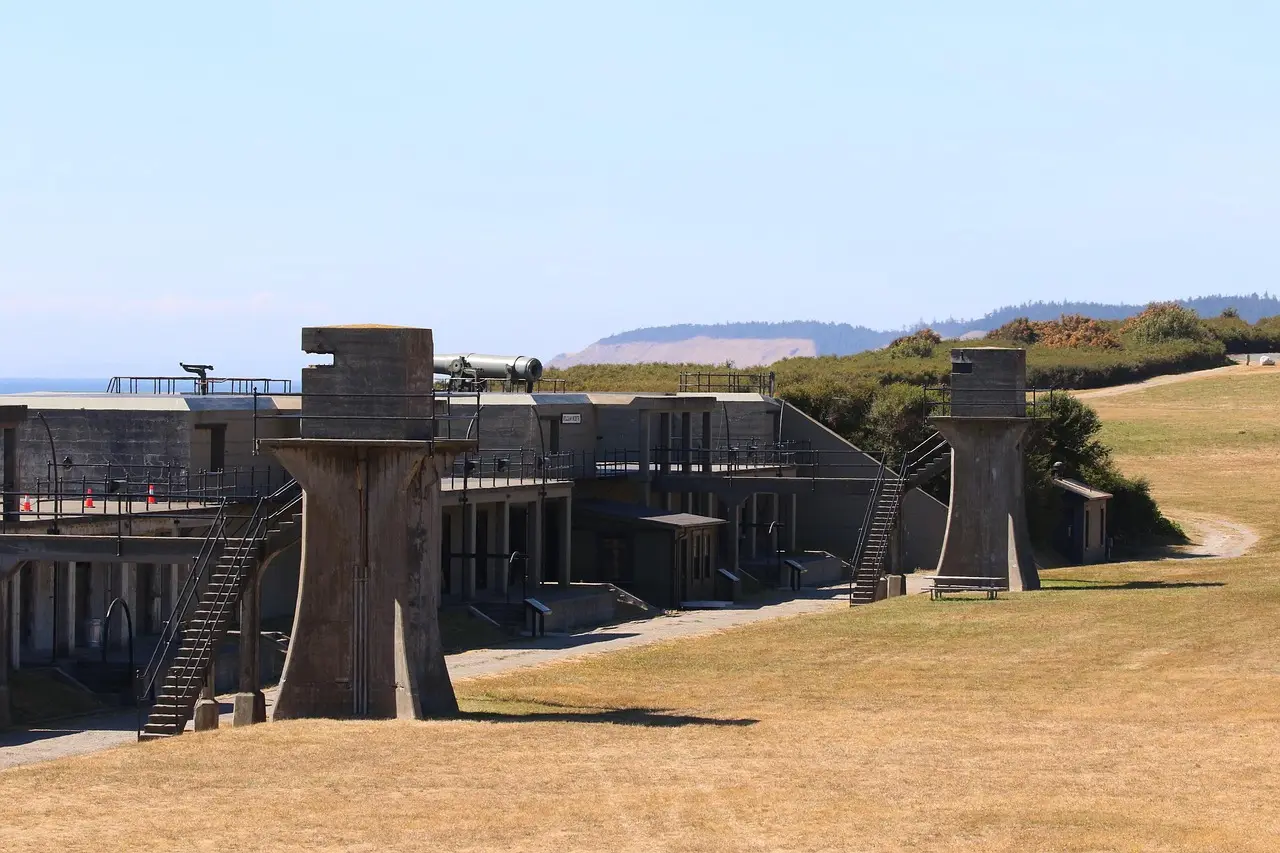
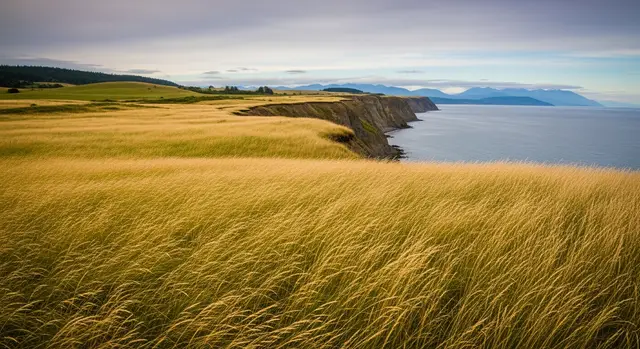
Fort Casey sits on Admiralty Head, on Whidbey Island, above Admiralty Inlet. The guns are still there. Congress authorized the Secretary of War to fortify the inlet at three points on June 6, 1896, the Army bought 123 acres from Dr. John C. Kellogg for $7,200 in 1897, and by the fall of 1905 the three-fort system had cost about $7.5 million.
Two Kellogg Land Sales, 1856 and 1897
The Army was not the first federal buyer here. In August 1856 Congress appropriated $25,000 for a lighthouse at Red Bluff, and $400 of that bought 10 acres from the Kellogg family. The Army came back forty-one years later and bought 123 acres from Dr. John C. Kellogg.
Maney, Goerig and Rydstrom of Everett began work on the emplacements in August 1897. In July 1899 the Army named the post for Brigadier General Thomas Lincoln Casey, its Chief of Engineers.
Thirty-Four Guns, or Thirty-Five
Washington State Parks dates construction to July 1897 and full operation to July 19, 1902. HistoryLink tells it differently: a temporary garrison in 1901, the permanent garrison in June 1902, permanent buildings in 1903.
They also disagree by one gun. State Parks counts 35 pieces at the peak — seven 10-inch disappearing guns, six 6-inch disappearing guns, two 5-inch balanced pillar guns, four 3-inch pedestal guns, and sixteen 12-inch mortars. HistoryLink counts 34, with six 10-inch guns instead of seven and every other figure identical. Both counts are published and neither has been withdrawn. The guns sat about 100 feet above the water.
Open Your Windows: May 5, 1903
The Army test-fired the guns on May 5, 1903. At least 26 soldiers worked a single 10-inch gun, and its shell weighed 617 pounds. The Daily Herald puts the range at roughly eight miles, the National Park Service at about seven.
Denisha Blondin, quoted in the Herald, described the warning that went out to the neighbors. “They’d tell them beforehand when they were test firing to open all their windows because the reverberation would shatter the windows.”
Thirteen Guns Went to Europe
In the First World War the Army dismantled thirteen of the fort’s guns and shipped them to European battlefields, to be fired there rather than scrapped. In the Second it reopened as an induction and training center. In 1942 every 10-inch and 12-inch gun here was dismounted and scrapped.
The Army shut the post down for good on June 30, 1953, the same day as Forts Worden and Flagler. Park guide Mary Bloom sums up the combat record: “There was never a shot fired in anger from this fort.”
The Pearsons at Red Bluff, 1864-1878
The Red Bluff light first showed on January 21, 1861 — a wooden Cape Cod-style tower on a two-story keeper’s dwelling, 40 feet high, its fixed fourth-order Fresnel lens visible more than 16 miles.
Keeper Daniel N. Pearson drew $1,000 a year. His daughter Flora, the assistant keeper, drew $625. She got the post in 1867 after her sister Georgianna, appointed alongside their father in 1864, married and left it.
What happened to that first building is not settled. HistoryLink says it was moved several hundred feet north, used by the Army as a temporary medical center and then as barracks for non-commissioned officers, taken down in 1928, and its lumber built into a house on south Whidbey Island. The Coast Guard’s own summary says the 1861 light was demolished. Both accounts are in print.
Nineteen Years of Light, 1903-1922
Carl W. Leick designed the replacement in California Spanish style: stucco over brick walls 18 inches thick, with a 30-foot conical tower. The light first showed on June 25, 1903. It went dark on June 30, 1922, after steam traffic moved to the opposite shore of Admiralty Inlet.
In July 1927 the Lighthouse Service unbolted the iron-and-glass lantern and shipped it to New Dungeness, whose tower Clarence Sherman had just cut from 91 feet to 63 feet to save money. It is still there. The lens in the museum today came out of Alki Point Lighthouse when that station was modernized in 1962. The Island County Historical Society began repairs in 1957, and the National Register of Historic Places listed the lighthouse on December 12, 1973.
Guns for Fort Casey Month, November 1965
Two 3-inch guns arrived from Fort Wint in Subic Bay on May 7, 1963. Getting the big ones took longer. Rear Admiral Arthur F. Spring first quoted $3,000 to take them apart, with Navy shipping free. His successor revised that to roughly $30,000. Governor Dan Evans declared November 1965 “Guns for Fort Casey Month,” and the 1967 Legislature put up $20,000.
The 10-inch pair did not ship until June 1968. On that voyage the container ship San Francisco hit a freak storm and took three 40-degree rolls. A 33-ton barrel broke loose on deck. A rib on the railing stopped it from going over the side. Matthew Bell of Washington State Parks told that story to Feliks Banel.
467 Acres and 10,810 Feet of Shoreline
Washington State Parks bought 105 acres on December 1, 1955. Seattle Pacific University bought the housing area in 1956 for its Camp Casey Conference Center. The state dedicated the park on September 9, 1962.
It holds 467 acres and 10,810 feet of saltwater shoreline inside Ebey’s Landing National Historical Reserve, which the 1978 National Parks and Recreation Act made the country’s first national historical reserve. Four guns are on display. Each 10-inch gun and carriage weighs about 125 tons. The pair hauled back from Subic Bay was dedicated on August 11, 1968, on the bluff the Army fortified after Congress authorized the work on June 6, 1896.
Sources
- Washington State Parks, Fort Casey Historical State Park. Primary/official. — construction dates, the 35-gun count, park acreage and shoreline, the 1955 purchase and 1962 dedication.
- National Park Service, Ebey’s Landing National Historical Reserve. Primary/official. — the reserve’s 1978 authorization and the gun range figure.
- National Register of Historic Places, Admiralty Head Lighthouse, listed December 12, 1973. Primary/official. — the 1903 lighthouse, its construction and listing date.
- U.S. Coast Guard historical summary, Admiralty Head Light. Primary/official. — the 1861 station, the Pearson keepers and their salaries, and the demolition account.
- HistoryLink.org, Fort Casey and Admiralty Head essays. Editorially reviewed secondary — attributed in text. — the 34-gun count, the garrison chronology, and the move-and-reuse account of the 1861 building.
- The Daily Herald (Everett), reporting on Fort Casey test firing. Editorially reviewed secondary — attributed in text. — the eight-mile range figure and the Denisha Blondin quotation.
- Feliks Banel, KIRO Newsradio, interview with Matthew Bell, Washington State Parks. Editorially reviewed secondary — attributed in text. — the 1968 shipment and the storm.
Two disagreements are left standing on purpose: the gun count, and the fate of the 1861 lighthouse. Both are recorded above rather than resolved by picking a side.