Start with the wooden building. It was never meant to hold an airplane. Edward W. Heath put it up in 1909 on the bank of the Duwamish, about five miles above the river’s mouth, as a shed for building boats. It ran 60 by 140 feet, part of it standing on pilings out over the water. The river wall was a set of massive double doors, and inside, the space ran clear from the dirt floor to the roof.
Heath was born in 1863 into a New Bedford shipbuilding family and had been in the trade since he was 23. In Michigan he advertised himself as a General Ship Builder, for barges, yachts, and upper cabin steamers.
Heath Went Broke Building a Yacht for William Boeing
The yacht was a custom job for William E. Boeing. It ruined Heath, and on March 23, 1910 Boeing bought the shipyard from him. Boeing’s people called it Heath’s, then the Oxbow.
Airplanes arrived in 1916. Boeing’s Pacific Aero Products Company dropped a second floor into the shed — 5,600 square feet, a third of it walled off into offices, the rest left open to build in. That autumn the workforce doubled, from six people to twelve. Boeing hired Wong Tsoo, a young Chinese aeronautical engineer just out of MIT. The second floor came out again in 1937 so a full-size mock-up of the Model 307 Stratoliner would fit, and went back in by 1942.
Two Miles Up the River on a Barge
By 1969 the Red Barn was a maintenance shop and a warehouse. Margaret Corley, writing its National Register nomination that year, noted some changed windows and then put her foot down: the basic structure, she wrote, was original and in sound condition. It was listed on August 26, 1971, having been nominated in the same King County batch as Pioneer Square, the Pike Place Market and the schooner Wawona.
Then they moved it. On January 30, 1975 the Port of Seattle lifted the barn and rolled it 600 feet to a corner of the site, where it sat up on shorings for ten months. Volunteers stripped off the later additions. On December 16 it was braced, jacked up, put on wheels and rolled down to the water. A Foss barge took it two miles up the Duwamish, under the First Avenue South bascule bridge, to Boeing Field. The move cost $32,000.
It then sat at a temporary spot for nearly five years. Not until November 24, 1980 did it reach the ground it stands on now.
One Man Heard It Was Coming Down
Harl Brackin was 39 in 1962, a Boeing wind-tunnel engineer since 1942 and the company’s first historian, when an executive mentioned the Red Barn was to be demolished. That, he said, was all this dreamer-author needed. He founded the Pacific Northwest Aviation Historical Foundation in 1965 with twelve trustees.
The restoration was fought over. In 1977 David Hansen at the state preservation office believed too much original fabric was being replaced, and that the old building was essentially being encased in a replica of itself to meet climate control goals. The acting state preservation officer agreed at first. The museum’s backers flew to Washington that autumn and made their case to the Park Service in a meeting arranged through Senator Warren Magnuson’s office. The work went ahead. What you walk into today is the barn as it looked around 1917. The painted Boeing Airplane Co. sign first went up on the west wall that year.
Brackin died in October 1977, six years too early. His widow Emma cut the ribbon with William Boeing, Jr. on September 1, 1983.
The Airplanes Worth Standing Under
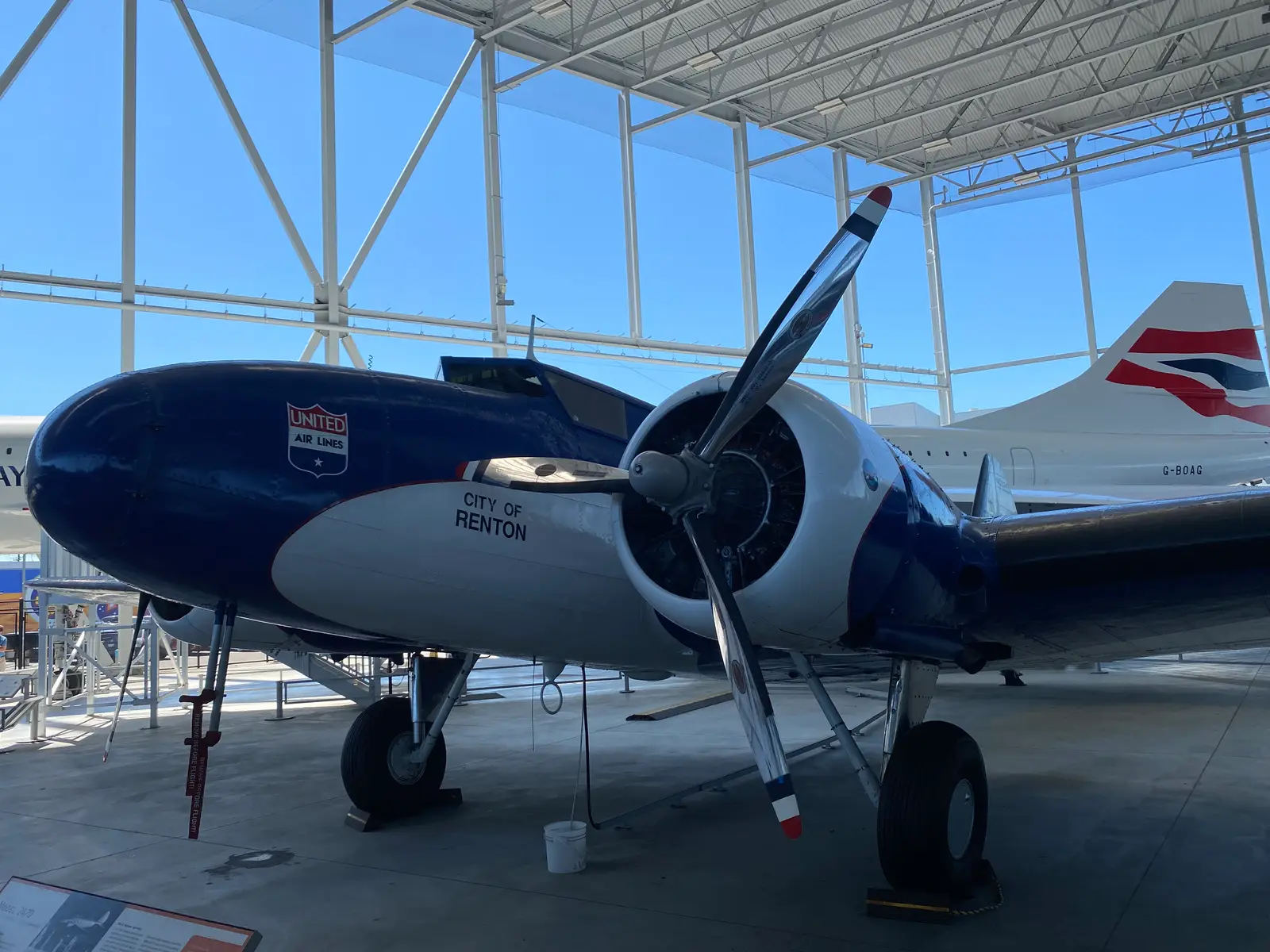
In the Great Gallery, a nine-ton Douglas DC-3 hangs from the ceiling in flight attitude, one of 39 aircraft currently in a six-story hall of glass and steel. Look for the Boeing 80A-1, the only survivor of the sixteen Model 80s built, pulled out of an Anchorage dump in 1960 and flown home in the belly of an Air Force C-124. The museum credits its restoration as the catalyst for the foundation that became this place.
Outside in the Aviation Pavilion sits SAM 970, the first presidential jet. Eisenhower became the first American president to fly by jet aboard it on August 26, 1959, and it went on to carry Kennedy, Johnson and Nixon, and to fly Henry Kissinger to the North Vietnamese peace talks.
The museum also has Concorde G-BOAG, which flew the last British Airways commercial Concorde service, New York to London, on October 24, 2003. Twelve days later, delivering itself here to retire, it ran New York to Seattle in 3 hours, 55 minutes, 2 seconds.
And there is RA001, the first 747 ever built. It first flew on February 9, 1969. Boeing gave it to the museum on April 6, 1995, on its own last flight.
The campus address says Seattle. The county files the Red Barn under Tukwila. Heath built it for boats.
Sources
- Lentz, Flo, and Sarah J. Martin. “Boeing Airplane Company Building” (Boeing Building 105; Boeing Red Barn; E.W. Heath Shipyard), City of Tukwila Landmarks Commission Landmark Registration Form, December 13, 2017, 62 pp. Hosted by the King County Historic Preservation Program. https://cdn.kingcounty.gov/-/media/king-county/depts/dnrp/building-property/historic-preservation-program/projects-and-programs/regional-preservation/downloads/tukwilaboeingredbarn.pdf — THE single most important document for this entry; contains the exact move wording, dimensions, dates and newspaper citations. — primary/official — see catalogue
- National Park Service, NPGallery NRHP record, “Building No. 105, Boeing Airplane Company,” reference number 71000872, listed August 26, 1971, King County, Washington. https://npgallery.nps.gov/AssetDetail/NRIS/71000872 — primary/official — see catalogue
- National Park Service, “Boeing Airplane Company Building No. 105,” NPS Articles. https://www.nps.gov/articles/boeing-airplane-company-building-no-105.htm — primary/official — see catalogue
- King County Historic Preservation Program, “King County and City Landmarks List,” Technical Paper No. 6, revised June 2025 — lists Boeing Airplane Co. Building 105 (1909), 9404 East Marginal Way S, designated 2018, under CITY OF TUKWILA. — primary/official — see catalogue
- The Museum of Flight, “History.” https://www.museumofflight.org/about/history — primary/official — see catalogue
- The Museum of Flight, “About.” https://www.museumofflight.org/about/ — primary/official — see catalogue
- The Museum of Flight, “Collections & Research.” https://www.museumofflight.org/exhibits-and-events/collections-and-research/ — primary/official — see catalogue
- The Museum of Flight, gallery pages: T.A. Wilson Great Gallery; Red Barn; J. Elroy McCaw Personal Courage Wing; Charles Simonyi Space Gallery; Aviation Pavilion; Museum Galleries index. https://www.museumofflight.org/exhibits-and-events/museum-galleries/ — primary/official — see catalogue
- The Museum of Flight, Air & Spacecraft index and individual aircraft/spacecraft pages: Concorde; Boeing VC-137B “Air Force One”; Boeing 747-121; Lockheed M-21 (Blackbird); Boeing B-17F Flying Fortress; North American P-51D Mustang; Boeing 80A-1; North American Aviation Apollo Command Module 007A; NASA Full Fuselage Trainer; Wright 1903 Flyer Reproduction; Wright 1902 Glider Reproduction; Nakajima Ki-43-IIIa Hayabusa “Oscar” Reproduction. https://www.museumofflight.org/exhibits-and-events/aircraft/ — primary/official — see catalogue
- The Museum of Flight press releases: “Work Begins April 6 on Museum’s New Aviation Pavilion” (April 6, 2015); “Jan. 31 Big Moving Day for Museum Airpark Aircraft” (January 27, 2015); “Seattle’s Museum of Flight Welcomes Space Shuttle Trainer: ShuttleFest 2012” (June 2012); “Space Shuttle Trainer Crew Cabin Arrives June 30” (2012); “Tours of Space Shuttle Trainer Crew Compartments Begin Feb. 15” (February 5, 2025). https://www.museumofflight.org/about/press/ — primary/official — see catalogue
- NASA, news release, “NASA to Hand Over Shuttle Trainer ‘Keys’ to Seattle Museum.” https://www.nasa.gov/news-release/nasa-to-hand-over-shuttle-trainer-keys-to-seattle-museum/ — primary/official — see catalogue
- Smithsonian Institution, Smithsonian Affiliations locator entry for The Museum of Flight. https://my.si.edu/locations/the-museum-of-flight — primary/official — see catalogue
- The Museum of Flight, Education pages, including “Washington Aerospace Scholars” and “Education” overview. https://www.museumofflight.org/education/ — primary/official — see catalogue
- The Boeing Company, “History of the Duwamish Waterway” (sustainability/environment). https://www.boeing.com/sustainability/environment/duwamish/history — confirms Plant 1 (‘the Red Barn’) as Boeing’s original manufacturing plant and the 1937-39 construction of Plant 2 on a 28-acre parcel along the Lower Duwamish; does not address the 1975 move. — primary/official — see catalogue
- HistoryLink.org (finding-aid only for this entry; no dedicated Museum of Flight or Red Barn essay located). Relevant adjacent essays: “Boeing Field, Seattle’s first municipal airport, is dedicated on July 26, 1928” (File 2077) and “Boeing Airplane Co., formerly Pacific Aero-Products, is officially incorporated on May 9, 1917” (File 372). Attribute in text if used. — editorial/secondary — see catalogue