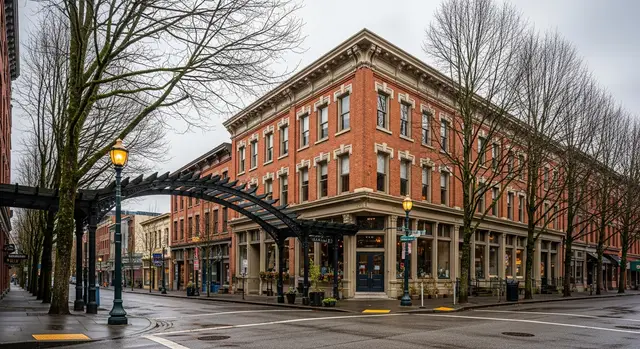
On this quiet corner in Georgetown, where industrial buildings and urban development now dominate the landscape, stands an invisible monument to one of the most transformative industries in Pacific Northwest history. Boeing acquired the building in 1910 (initially in connection with a yacht), and by 1916 he had established his first aircraft manufacturing facility in this simple red barn, which would become the humble birthplace of what would grow into the world’s largest aerospace company. Though the actual Red Barn was relocated to the Museum of Flight in 1975, this Georgetown location remains sacred ground in aviation history, the spot where the Pacific Northwest’s aerospace industry took its first tentative flight.
The Visionary and His Barn
William Edward Boeing arrived in Seattle in 1903 as a young timber magnate, but his life changed forever when he witnessed his first airplane flight at the Alaska-Yukon-Pacific Exposition in 1909. Frustrated by the poor quality of available aircraft and convinced he could build better machines, Boeing partnered with naval engineer George Conrad Westervelt to establish the Pacific Aero Products Company in 1916.
The original Red Barn, a wooden structure measuring about 150 by 65 feet, became Boeing’s first manufacturing facility. Located on the banks of the Duwamish River in Georgetown, the barn provided both workspace and waterfront access essential for testing the company’s early seaplanes. This strategic location, with its proximity to Seattle’s industrial infrastructure and transportation networks, would prove crucial to Boeing’s early success.
The barn’s humble appearance belied its revolutionary purpose. Within its wooden walls, Boeing and his small team of craftsmen hand-built their first aircraft, the B&W Seaplane (Boeing & Westervelt), using techniques that combined traditional woodworking with emerging aviation technology. Every component was crafted by hand, from the wooden framework to the fabric covering, representing the personal touch that would distinguish Boeing’s early aircraft from mass-produced competitors.
Aviation Pioneers
The Red Barn served as more than a manufacturing facility, it functioned as an experimental laboratory where Boeing and his team solved fundamental problems of early aviation. The company’s first aircraft, the B&W Seaplane, made its maiden flight on June 15, 1916, launched from nearby Lake Union. This successful flight validated Boeing’s belief that superior engineering and craftsmanship could overcome the reliability problems that plagued early aviation.
The barn’s location on the Duwamish River provided natural advantages for seaplane development and testing. Boeing’s early aircraft could be launched directly from the water, eliminating the need for expensive runway facilities while taking advantage of the region’s abundant waterways. This geographic advantage helped establish the Pacific Northwest as a natural center for aviation development.
Working conditions in the Red Barn were primitive by later standards but revolutionary for their time. Boeing insisted on precision manufacturing techniques that exceeded industry norms, establishing quality standards that would become company hallmarks. The small team of craftsmen who worked in the barn included some of aviation’s unsung pioneers, skilled woodworkers, fabric specialists, and mechanics who adapted their traditional crafts to the demands of aircraft construction.
Military Contracts and Growth
World War I transformed Boeing from a small experimental company into a significant military contractor. The U.S. Navy ordered 50 Model C seaplanes, Boeing’s first major production contract, requiring expansion beyond the Red Barn’s limited capacity. However, the barn continued serving as headquarters and experimental facility even as Boeing established larger manufacturing plants.
The military contracts validated Boeing’s approach to aircraft manufacturing while providing capital for expansion and technological development. The company’s success in meeting military specifications and delivery schedules established Boeing’s reputation for reliability and quality that would attract future contracts and civilian customers.
The Red Barn period established Boeing’s corporate culture of innovation and quality that would define the company throughout its growth into a global aerospace giant. The intimate scale of the barn operation, where William Boeing personally supervised production and maintained close relationships with his craftsmen, created standards and values that would influence Boeing’s approach to manufacturing for decades.
Engineering Innovation
The Red Barn era saw Boeing’s first major engineering innovations, including improvements in wing design, control systems, and structural engineering that enhanced aircraft performance and safety. Boeing’s engineers, working in close collaboration with skilled craftsmen, developed manufacturing techniques that combined precision engineering with practical construction methods.
The company’s focus on seaplanes during the Red Barn period reflected both market opportunities and the Pacific Northwest’s geographic advantages. Boeing’s seaplanes achieved superior performance compared to competitors, demonstrating the effectiveness of the company’s engineering approach and manufacturing quality standards.
Experimental work conducted in the Red Barn laid foundations for Boeing’s later achievements in commercial and military aviation. The company’s commitment to continuous improvement and technological innovation, established during these early years, would drive Boeing’s evolution from a small regional manufacturer to a global aerospace leader.
The Red Barn’s story parallels the broader transformation of the Pacific Northwest from a resource-extraction economy to a center of high-technology manufacturing. Boeing’s success attracted related industries, skilled workers, and supporting infrastructure that would establish the region as a major aerospace cluster.
The company’s growth beyond the Red Barn created thousands of jobs and attracted engineering talent from across the country. Boeing’s success demonstrated that the Pacific Northwest could compete in sophisticated manufacturing industries, helping diversify the regional economy beyond traditional timber and fishing industries.
The aerospace industry’s establishment in the Pacific Northwest created a skilled workforce and technological infrastructure that would support the region’s later development in electronics, software, and other high-technology industries. Boeing’s success provided a model for other technology companies that would choose the Pacific Northwest as their home base.
Preservation and Legacy
The Red Barn’s relocation to the Museum of Flight in 1975 preserved this historic structure while making it accessible to the public. The careful restoration process documented original construction techniques and materials, providing insights into early aviation manufacturing methods and the craftsmanship that made Boeing’s early success possible.
The barn’s new location at the Museum of Flight creates educational opportunities that connect visitors to the personal scale of early aviation development. Visitors can experience the intimate workspace where Boeing’s founders hand-built their first aircraft, understanding the human dimension of technological innovation that often gets lost in accounts of corporate growth and industrial development.
The preservation effort required extensive research into the barn’s original appearance and construction methods. Museum staff interviewed former Boeing employees, studied historical photographs, and analyzed original materials to ensure accurate restoration of this significant historical artifact.
Modern Significance
Today, the Georgetown site where the Red Barn originally stood reminds us of how transformative industries can emerge from humble beginnings. The location’s industrial character reflects the practical considerations that influenced Boeing’s early success, access to transportation, skilled workers, and supporting infrastructure that enabled rapid growth.
The site’s significance extends beyond Boeing’s corporate history to represent the entrepreneurial spirit and technological innovation that has defined the Pacific Northwest’s economic development. The Red Barn story demonstrates how individual vision combined with regional advantages can create industries that transform entire regions.
For aviation enthusiasts and historians, the original Red Barn site represents hallowed ground, the actual location where the Pacific Northwest aerospace industry began. While the barn itself has been moved, the geographic location retains its historical significance as the birthplace of Boeing and the launching point for the region’s aerospace industry.
Educational Value
The Red Barn’s story provides valuable lessons about entrepreneurship, innovation, and the relationship between individual vision and regional development. William Boeing’s decision to establish his company in Georgetown reflects the importance of strategic location decisions in business success.
The barn’s evolution from simple workshop to symbol of industrial achievement illustrates how great enterprises often begin with modest resources and ambitious dreams. Boeing’s success required not just technical innovation but also business acumen, strategic thinking, and the ability to adapt to changing market conditions.
The preservation and interpretation of the Red Barn site offers opportunities to explore themes of technological development, regional economic transformation, and the human stories behind industrial achievement. These educational opportunities help visitors understand how individual decisions and local conditions can create outcomes that influence global industries.
Continuing Innovation
Boeing’s growth from the Red Barn to become the world’s largest aerospace company demonstrates the long-term impact of the innovations and standards established during the company’s earliest years. The commitment to quality, precision, and continuous improvement that characterized the Red Barn era continues to influence Boeing’s approach to aircraft design and manufacturing.
The company’s ongoing presence in the Pacific Northwest, with major facilities throughout the region, reflects the lasting advantages that attracted William Boeing to establish his company in Georgetown over a century ago. The region’s skilled workforce, transportation infrastructure, and innovation culture continue supporting Boeing’s success while attracting other aerospace and technology companies.
The Red Barn’s legacy lives on in every Boeing aircraft that takes flight, connecting the company’s current achievements to its humble beginnings in a simple wooden barn on the banks of the Duwamish River. This connection between past and present demonstrates how historical preservation and corporate success can work together to honor legacy while building for the future.
A Sacred Site
Though the physical Red Barn has been moved, the Georgetown location remains a sacred site in aviation history. Here, in 1916, William Boeing took the first steps toward building what would become the world’s largest aerospace company, establishing the Pacific Northwest as a global center of aviation innovation.
The site reminds us that great achievements often begin with simple tools, modest facilities, and ambitious dreams. Boeing’s success story, which began in this Georgetown barn, demonstrates how individual vision combined with regional advantages can create industries that transform the world.
For visitors to this historic site, the Red Barn’s story offers inspiration and perspective on the relationship between innovation and achievement. The humble beginnings represented by this location remind us that today’s global giants once started with individuals willing to take risks, work hard, and pursue their vision despite uncertain odds.
Standing at the original Red Barn location, visitors can imagine the sounds of hand tools shaping wood, the smell of fabric and glue, and the excitement of craftsmen building machines that would lift humans into the sky. Though the barn itself has been moved, the spirit of innovation and achievement that it represented continues to inspire new generations of entrepreneurs and dreamers who seek to transform their own ambitious visions into reality.