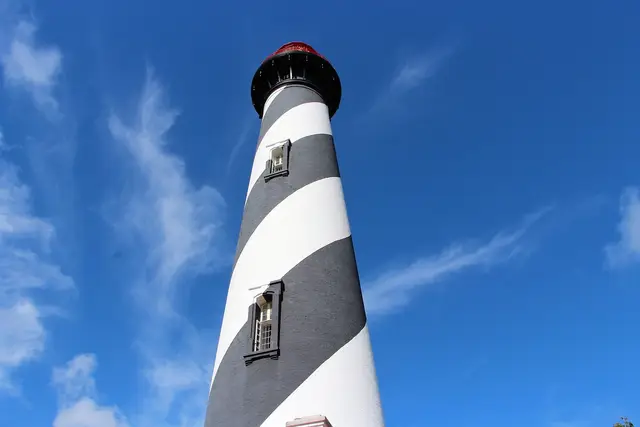
The light station sits on Mukilteo Point at the edge of Possession Sound, on 1.46 acres. Nobody ever lived in the tower. Congress appropriated $22,000 on January 9, 1903, the Light House Service began building in 1905 and finished in eight months, and the lamp first burned on March 1, 1906 — five years before the first passenger ferry ran to Whidbey Island.
The Vessel That Nearly Went Ashore, February 21, 1902
A near miss put it here. The Secretary of the Treasury wrote to the Speaker of the House on February 21, 1902. His letter, quoted in the National Register nomination, said the tides “are very strong and deceiving at Muckilteo Point.” Then came the line that bought the building: “[s]ome time ago one of the large San Francisco vessels narrowly escaped running ashore there in a fog.”
The Light House Board wanted it for Everett-bound vessels and for traffic up Possession Sound and Saratoga Passage. Lumber and coastwise commerce made the case. No ferry figured in it at all. HistoryLink dates passenger service to Whidbey at 1911, car service at 1916 by tug and barge, and the Washington State Ferries takeover at 1951.
Carl Leick Framed It in Wood, 1905
Carl W. Leick (1854-1939) drew it. He had drafted for the 13th Lighthouse District since 1889, and his Grays Harbor (1898) and Admiralty Head (1903) lighthouses also survive. He framed this tower in wood at a time when most lighthouses went up in brick and concrete. His motto, per the nomination: “Build ‘em stout, and make ‘em last.”
How tall is it? The federal record does not agree with itself. The 1977 nomination gives 33 feet above the water. The 2008 form says 35 feet on one page and a “38-foot, octagonal tower” nine pages later. Triangular squinches carry the square first floor up to an octagonal second story, and thirty-six risers climb from the watch room to the lantern house.
Every Three Hours, Christiansen Started Over
Every three hours the keeper refilled the oil lamp, trimmed the wick, adjusted the air intake in the tower, and rewound the clockwork that turned the lens. Then he oiled the compressor that drove the foghorn.
That horn was a Daboll trumpet, made by Celadon L. Daboll of New London, Connecticut. Compressed air crossed a vibrating reed. In fog its bass notes sounded every 16 seconds and could be heard up to eight miles away. On the opening, a reporter for the Everett Morning Tribune wrote that “dozens of people curiously watched the glint of the lamp as it shot its beam of yellow light in the direction of the city at regular intervals.”
Peter Christiansen, Sailor and Keeper, 1906-1925
Peter N. Christiansen (1858-1925) took the first keeper’s job here. A Norwegian immigrant, he had spent 21 years at sea, ten of them in the U.S. Navy, before joining the Lighthouse Service in 1893.
The Mukilteo Historical Society, reading the 1905 Official Register, puts his pay that year at $800 — the year before he transferred here from Turn Point. The same register describes him: five feet five, blue eyes, a “sailor with girl” tattoo on his left forearm. He died on October 5, 1925, presumably of a heart attack, after helping unload a large shipment of coal for the station. Vivian R. Corrie held the post from 1946 to 1960, the longest tour anyone served at Mukilteo.
The 1852 Lens, Installed in 1927
Electricity reached the tower in 1927. The Lighthouse Service pulled the original rotating lens and set in a fourth-order Fresnel lens made in France in 1852. The 1977 nomination records the maker as “L. SAUTTER & CIE, Paris.”
In the 1960s the Coast Guard announced a plan to demolish the station and swap that Fresnel for a modern rotating beacon. The nomination says the Mukilteo community “protested vehemently.” The lens stayed.
The Windmill Was the Town Water Supply
A windmill stood over the station well and pumped fresh water to the town of Mukilteo. Hydroelectric power reached town and the windmill went out of use. It came down in the early 1930s.
A 22-inch metal triangle on a six-foot post survives from about 1935. It was rung “to warn the town’s people of a fire at the station or a distressed vessel at sea.”
Three Contributing Buildings in 1977, Thirteen in 2008
The National Register listed the station on October 21, 1977, reference number 77001360. Mildred Andrews, PhD, wrote a second nomination in 2008 that raised the count to 13. The period of significance runs from 1906 to 1935.
The state parks commission acquired 17 adjacent acres in 1954. The Coast Guard added an acre of swampy ground, leaving the station 1.46 acres. The Coast Guard automated the light and the fog signal in July 1979 and cut the complement to a single caretaker. Boatswain’s Mate Kurtis Betz, there from 1986 to 1990, was the last of them. Rep. Jack Metcalf introduced the transfer bill and the city took ownership in spring 2001. In April 2026 the Legislature put $206,000 toward stabilizing the keepers’ quarters against wood rot.
Still Lit, Flashing White Every Five Seconds
The light stays lit 24 hours a day: flashing white every five seconds, nominal range 12 nautical miles. The horn still answers a mariner who asks for it. Key the microphone five times on VHF channel 83 alpha and it blasts three seconds every 30 seconds for the next half hour.
The museum is in the Assistant Keeper’s Quarters, the archives in the Keeper’s Quarters, the interpretive center in the oil house. The station was built for lumber schooners, and no ferry figured in the case for it. In 2025 the Mukilteo-Clinton run carried 2,108,135 vehicles on 26,338 sailings, more than any other Washington State Ferries route that year. Nobody lives in the tower.
Sources
- National Register of Historic Places Registration Form, Mukilteo Light Station (2008), prepared by Mildred Andrews, PhD. Primary/official. npgallery.nps.gov — the 1902 Treasury letter, the 1903 appropriation, the 1905-06 construction and opening, Carl Leick, the tower-height discrepancy, the Daboll trumpet, the keeper’s routine, the 1927 electrification and 1852 lens, the windmill and alarm triangle, Christiansen and Corrie, the 1979 automation, the 1960s demolition plan, the 1977 listing and 2008 expansion, and the 1954 land transactions.
- National Register Inventory-Nomination Form, Mukilteo Light Station (1977), prepared by Lt. R. J. Williamson, USCG. Primary/official. — the 33-foot figure and the lens maker.
- U.S. Coast Guard Light List, Volume VI (2025), LLNR 18460. Primary/official. — the light characteristic, range, and mariner-activated horn.
- WSDOT, Washington State Ferries Fact Sheet 2026. Primary/official. — 2025 route traffic.
- Office of Sen. Marko Liias, April 7, 2026. Primary/official. — the $206,000 appropriation.
- Mukilteo Historical Society, “Our First Light Keepers” (2020). Editorially reviewed secondary — attributed in text. — Christiansen’s 1905 salary and description.
- HistoryLink.org, Essay 8422, “Mukilteo — Thumbnail History.” Editorially reviewed secondary — attributed in text. — the ferry chronology.
Dropped for lack of an acceptable source: the “only active Fresnel lens in Washington” claim, any single unhedged tower height, the candlepower dispute, the 14-mile visibility figure, the original 1906 lens maker, and the ferry-dependency, radio, postmaster, visitation and volunteer-hours claims carried in the previous version.