Indigenous Heritage (10,000+ Years)
The land where Fay Bainbridge Park sits today has been home to the Suquamish people for over 10,000 years. The Suquamish, whose name derives from dxʷsəq̓ʷəb meaning “people of the clear saltwater,” established numerous winter villages throughout this region, including settlements at nearby Port Madison, Eagle Harbor, and Battle Point.
This region is anchored by Old Man House (dxʷsəq̓ʷəb), which stood a few miles across Agate Passage in present-day Suquamish and was the largest winter longhouse in Washington State. Length estimates for this massive cedar structure range from roughly 500 to 900 feet, at about 60 feet wide, and it served as the winter home of Chief Seattle (Si’ahl) and Chief Kitsap, two of the most influential Pacific Northwest indigenous leaders.
The Bainbridge Island region witnessed a pivotal moment in Pacific Northwest history when British explorer Captain George Vancouver anchored at Restoration Point, at the southeast tip of the island, in 1792, far from this park at the island’s northeast tip. This marked an early recorded contact between Europeans and the Suquamish people, featuring trade exchanges and survey work of local waters. The Suquamish received the Europeans with diplomacy and curiosity, beginning a complex period of cultural encounter.
The signing of the Treaty of Point Elliott in 1855 fundamentally changed Suquamish life. Chief Seattle and other tribal leaders signed this treaty, ceding traditional territory (including Bainbridge Island) to the United States in exchange for the Port Madison Indian Reservation and guaranteed fishing rights. While some Suquamish families relocated to the reservation, others chose to remain in traditional village sites throughout their ancestral territory.
Medical Pioneer Legacy (1944)
The park was established in 1944, when the State of Washington purchased the land for $5,000 from the estate of Dr. Temple Sedgwick Fay (1895–1963), on the condition that it retain the Fay name. Born in Seattle and an undergraduate at the University of Washington, Fay went on to a distinguished neurosurgical career in Philadelphia, where he served as head of neurosurgery at Temple University School of Medicine and pioneered the use of therapeutic hypothermia — deliberately cooling the body — to treat brain injuries and tumors. His two children honored his wish to preserve the property as a public park.
Maritime Heritage
The park contains the historic Port Madison Bell, brought from San Francisco in 1883 by Captain Jeremiah W. Farnham. Originally intended as a “town crier” to announce important community events to Port Madison citizens, the bell moved between various community buildings before being permanently installed at the park entrance in 1953, donated by the Kitsap County Historical Society.
Cultural Landscape Today
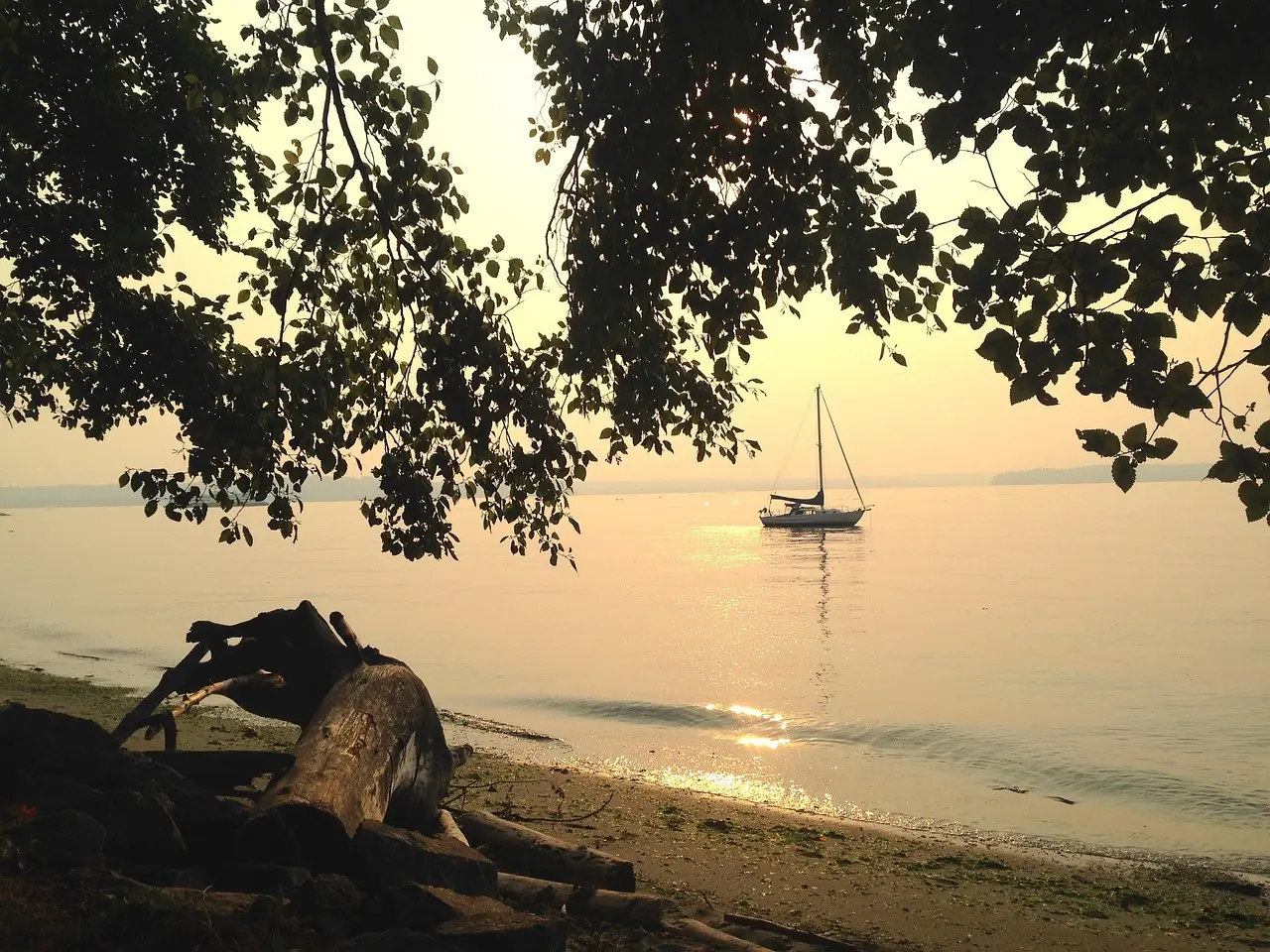
Today, Fay Bainbridge Park offers 1,420 feet of Puget Sound shoreline with stunning views of the Cascade Mountains, Mount Rainier, and Mount Baker. The 17-acre marine park serves as both a recreational area and a place for reflection on the complex history of cultural encounter and change in the Pacific Northwest.
The Coast Salish peoples who managed these marine and forest ecosystems for millennia practiced sophisticated resource management, including seasonal salmon fishing, shellfish harvesting, and careful stewardship of forest resources. Their sustainable practices created the abundant natural environment that continues to define this region.
- Open: Dawn to dusk daily
- Facilities: Camping areas, picnic tables, beach access, restrooms, historic bell display
- Activities: Beachcombing, tide pooling, photography, camping, historical reflection
- Management: Bainbridge Island Metro Parks & Recreation District
- Contact: (206) 842-3931
Getting There
From Seattle, take the Washington State Ferry from Colman Dock to Bainbridge Island (35-minute scenic crossing). From the ferry terminal, head north on Olympic Drive SE, turn right on High School Road NE, left on Madison Avenue NE, then right on Sunrise Drive NE to reach the park entrance.
This location represents the enduring connection between the Suquamish people and their ancestral lands, the complexity of cultural encounter in the Pacific Northwest, and the vision of individuals like Dr. Fay who sought to preserve natural spaces for future generations.