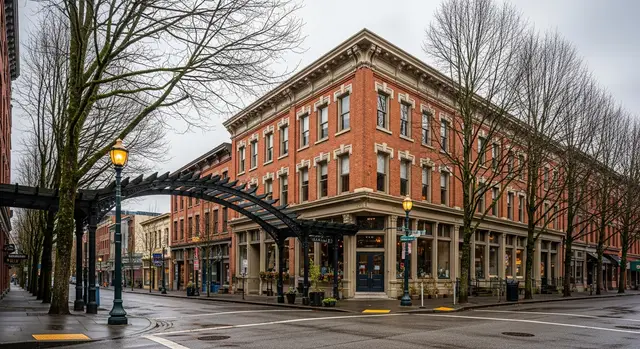
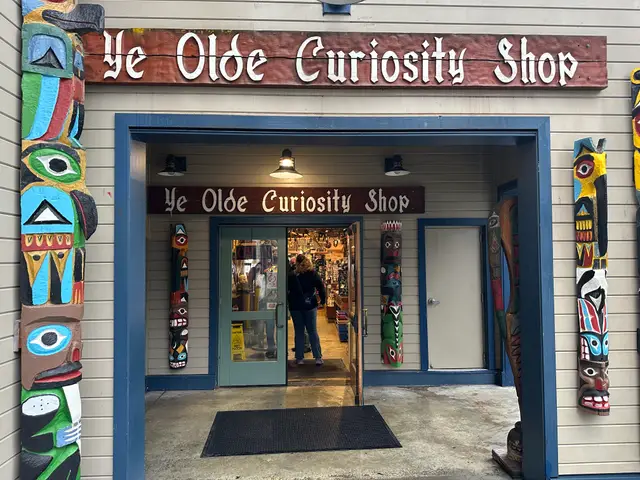
Beneath the sidewalks of Pioneer Square lies a shadow city — the ghost of Seattle’s original street level, complete with buried storefronts, doorways to nowhere, and skylights of purple glass overhead where pedestrians stroll unaware. Unlike some underground legends, this one is solid fact: Seattle really did raise its downtown streets a full story and abandon the old ground floors below. The legend part — the speakeasies, the opium dens, the ghosts — came later, and we’ll get to it. First, the true story, which is strange enough.
A City Built Too Low, Then Burned
Early Seattle made a foundational mistake: it built its commercial district on low, muddy ground at the edge of the tideflats. At high tide, the primitive sewers ran enthusiastically in reverse — accounts of the era’s exploding toilets and flooded streets are a staple of every telling, and the drainage problem itself is well documented.
Then came the reset. On June 6, 1889, a fire that began in a woodworking shop swept through downtown, destroying most of the city’s commercial core and waterfront — the Great Seattle Fire, documented in detail by historians at HistoryLink. Astonishingly, no one is recorded to have died in the blaze, and the city treated the disaster as an opportunity: it would rebuild in brick and stone, and it would finally fix the flooding by raising the streets themselves.
Raising the Streets
In the years after the fire, the city raised the street levels in Pioneer Square by one to two full stories — up to about 18 feet in places, according to HistoryLink — by building retaining walls along the roadways and filling in between. (This street-raising is distinct from the later, larger Denny Regrade that flattened hills north of downtown.)
Property owners, rebuilding fast, couldn’t wait for the slow public works to catch up, so for a time the new brick buildings fronted onto old, low streets — with the understanding that today’s ground floor would become tomorrow’s basement. The transition produced a genuinely surreal cityscape: streets a story above the sidewalks, reached by ladders at crosswalks. When new elevated sidewalks finally bridged the gap, the original sidewalks and storefronts below were entombed, lit by grids of glass prisms set into the pavement above — the amethyst-tinted “vault lights” still visible today, one of the underground’s most beautiful details.
For a while, commerce carried on at both levels. Gradually the action moved upstairs for good, and the old ground floors became storage rooms, workshops, and forgotten voids.
The Lore: Speakeasies, Opium Dens, and Condemned Sidewalks
Here’s where documented history and beloved storytelling start to interleave — and it’s worth knowing which is which.
Pioneer Square’s rough-and-tumble reputation is genuine: the neighborhood south of Yesler Way was Seattle’s notorious vice district in the late nineteenth and early twentieth centuries, thick with saloons, gambling rooms, and brothels. That part is standard, well-documented Seattle history.
The specifically underground version of that history — Prohibition speakeasies humming beneath the sidewalks, opium dens in the buried storefronts, escape tunnels for bootleggers — is the stuff tour guides tell in the dark, and it should be enjoyed that way. Historians have documented the underground’s post-abandonment life mainly as storage space and refuge for transients; we did not find documented, verified cases of speakeasies operating in the buried sidewalk areas. Given that vice of every kind flourished in the buildings above, some of it surely leaked downstairs — but the candlelit underground speakeasy is lore until someone produces the receipts.
Likewise the famous claim that the city condemned the underground in 1907 for fear of bubonic plague: it’s repeated in nearly every popular account and by the tour itself, but it’s hard to trace to primary records, so treat it as tradition rather than settled fact. What’s certain is that by the early twentieth century the underground had been sealed off, forgotten, and left to rats, dust, and the occasional trespasser.
Bill Speidel and the Great Rediscovery
The underground owes its second life to Bill Speidel, a publicist, newspaper veteran, and gleeful debunker of what he called “pasteurized history.” Speidel had been poking around the buried sidewalks and writing about them when, on August 3, 1964, a Seattle Times column mentioned that he’d guided occasional groups below — and invited curious readers to contact him. Speidel later said he received some 300 letters and a flood of calls within two days. When he staged a tour, hundreds of people showed up. He took the hint: according to HistoryLink, regularly scheduled Underground Tours began on Memorial Day weekend in 1965, launching from Doc Maynard’s Saloon with a troupe of student guides.
Speidel’s 1967 book Sons of the Profits delivered his irreverent, scandal-forward version of early Seattle history, and his tours mixed real regrade engineering with cheerfully embroidered yarns — a blend the tour proudly continues. Crucially, the tour’s popularity became preservation leverage: Speidel helped lead the fight that saved Pioneer Square from demolition, with the neighborhood designated a historic district and placed on the National Register of Historic Places in 1970. It is not much of an exaggeration to say a walking tour of old basements saved Seattle’s oldest neighborhood.
What You’ll Actually See
The tour route passes through genuine 1890s subterranean sidewalks and storefront remnants: rusted pipes, old signage, abandoned fixtures, brick and timber from the post-fire rebuild, and those glowing prism skylights. It’s an authentic piece of urban archaeology — a nineteenth-century streetscape preserved by abandonment rather than intention — wrapped in first-class storytelling. New pockets of the old street level still turn up during downtown construction and renovation work, each one a small time capsule of the rebuilt city.
Why It Matters
Underground Seattle is that rare attraction where the verified history outshines the legend. A young city burned to the ground, then jacked its streets into the air to beat the tides — an act of civic audacity you can still walk through, one story down. The ghost stories and speakeasy tales are the seasoning, and worth savoring as such. The buried city itself is the real thing: proof, in brick and glass prisms, that Seattle has always preferred reinvention to resignation.