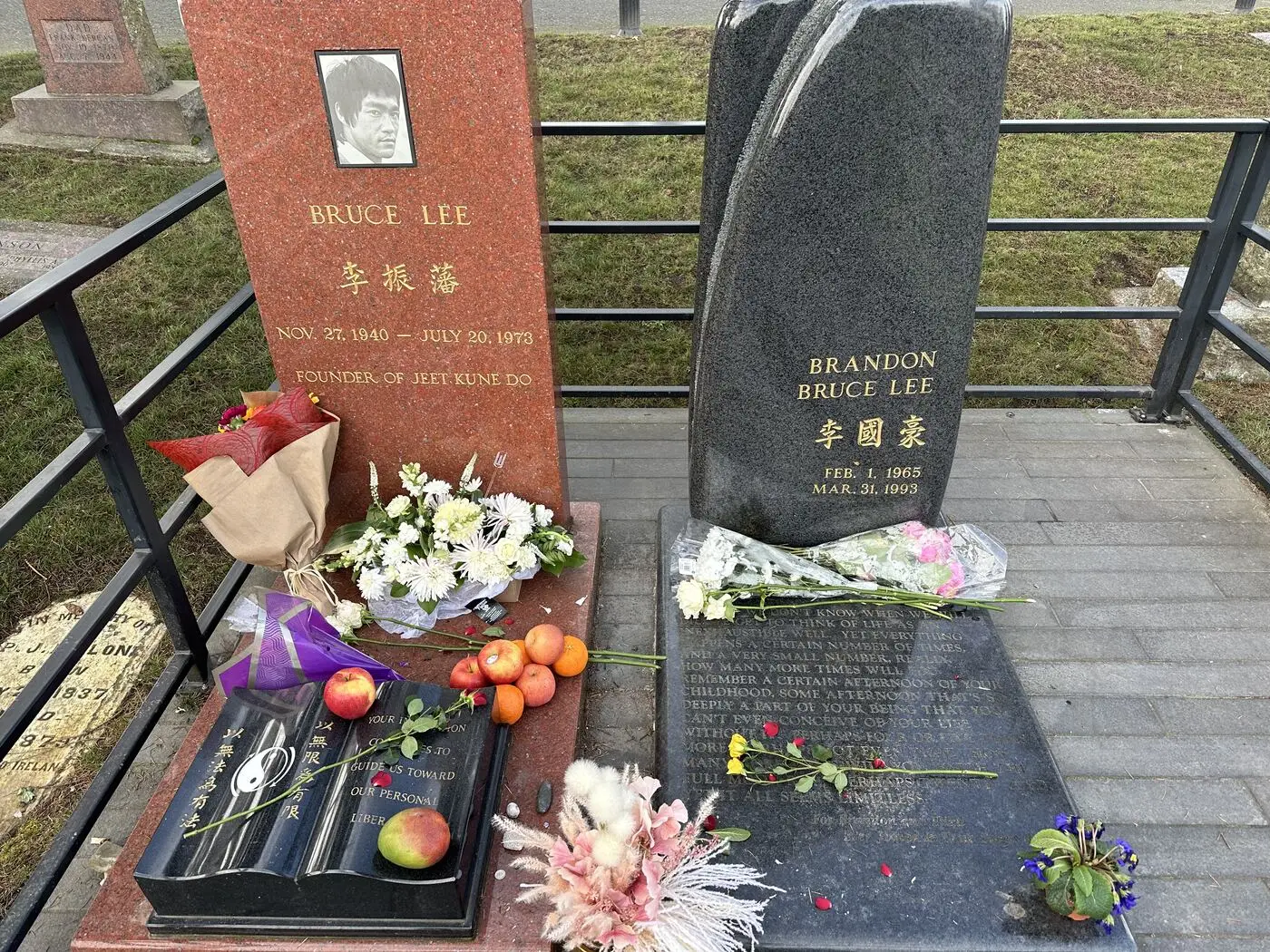
The cemetery sits on a quiet hill above Capitol Hill’s rooftops, its paths winding beneath Douglas firs and cedars. Lake View Cemetery holds many of Seattle’s founding families — pioneers, civic leaders, early settlers whose names appear on street signs and neighborhoods throughout the city. But for the past half-century, many visitors have come looking for two headstones in particular — one red granite, one black — standing side by side near the crest of the hill.
Bruce Lee’s Seattle
Bruce Lee arrived in Seattle in 1959, eighteen years old and carrying little more than family connections and an extraordinary restlessness. His father, the Cantonese opera star Lee Hoi-chuen, had sent him from Hong Kong to America partly to create distance from the street trouble he had fallen into as a teenager. Seattle had a small but established Chinese American community, and family connections made it a reasonable landing point.
What nobody could have anticipated was how deeply the city would shape him.
Lee finished his high school diploma at Edison Technical School (a predecessor of today’s Seattle Central College) and lived and worked at Ruby Chow’s, the well-known Chinese restaurant on Jefferson Street run by the future King County councilmember of the same name. He read voraciously — philosophy, physics, psychology — checking armloads of books out of the Seattle Public Library and filling notebooks with ideas about movement, energy, and human potential. In 1961 he enrolled at the University of Washington, where philosophy became a defining intellectual pursuit. The interest was deliberate. Lee was less concerned with the mechanics of martial arts than with the underlying principles governing all physical movement and performance. His UW notebooks contain passages from Descartes and Krishnamurti alongside diagrams of striking techniques and training schedules.
The Jun Fan Gung Fu Institute
While still a student, Lee opened his first formal martial arts school. In the fall of 1963, the Jun Fan Gung Fu Institute — Jun Fan being his Chinese given name — opened at 4750 University Way in the University District, after Lee had spent several years teaching informally around the city. He taught his gung fu, grounded in the Wing Chun he had studied in Hong Kong, to whoever wanted to learn, regardless of race or background.
That last point was not trivial. By long custom, many Chinese martial arts teachers of the era instructed only Chinese students. Lee refused this arrangement. His willingness to teach anyone who showed genuine commitment made him both celebrated and controversial, and it planted the seeds of what would eventually become known as Jeet Kune Do.
Linda Emery and a Family Rooted Here
Lee met Linda Emery, a Seattle student who first encountered him while she was at Garfield High School and became one of his martial arts students, later joining him at the University of Washington. They married in Seattle on August 17, 1964. Their son Brandon was born on February 1, 1965, in Oakland, where the family had moved after Lee left the university to pursue martial arts full time. But Seattle remained the anchor — Linda’s family was here, and the connections Bruce had built during his most formative years gave the city a permanent place in the Lee family’s story.
The Legacy
By the time of Bruce Lee’s death in Hong Kong on July 20, 1973, at age 32, he had already altered global culture in ways that are difficult to fully measure. His films had made martial arts cinema into a worldwide phenomenon. His philosophy of combat had challenged the rigid traditions of every established martial arts system. His insistence that physical training was inseparable from philosophical inquiry gave serious intellectual credibility to disciplines that had often been treated as mere athletics.
Linda Lee brought his body home to Seattle. He is buried here, at Lake View Cemetery, beneath a red granite headstone bearing his portrait, his name in both English and Chinese characters, and the inscription “Founder of Jeet Kune Do.”
Brandon
Brandon Lee grew up partly in his father’s enormous shadow and partly, as he got older, in his own emerging light. He had his father’s physical gifts and his mother’s roots in the Pacific Northwest, and by his late twenties he had built a serious acting career that was finally standing on its own terms.
He was filming The Crow in Wilmington, North Carolina, in March 1993 when a prop-gun accident on set ended his life. He was 28. Linda Lee brought him home as well, and he was buried beside his father.
The two headstones stand a few feet apart beneath the trees — Bruce’s red granite beside Brandon’s darker black stone. Brandon’s grave carries a line, drawn from Paul Bowles’s novel The Sheltering Sky, that has stayed with many visitors: Because we don’t know when we will die, we get to think of life as an inexhaustible well. Brandon was engaged to Eliza Hutton, and their wedding was only weeks away when he died.
A Living Memorial
What distinguishes these graves from most cemetery memorials is the constancy of visitors. Flowers arrive daily, left by people from every country and walk of life. Martial arts students come with offerings. Film enthusiasts come to pay respects. Tourists who have traveled from Japan, Brazil, or Germany include it on itineraries alongside Pike Place Market and the Space Needle.
The offerings left at the headstones are eclectic: flowers, incense, coins, handwritten notes, photographs, sometimes a worn copy of one of Lee’s books. On Bruce Lee’s birthday in 2013, forty years after his death, the cemetery recorded flowers piled as high as the headstones themselves.
What draws people here is harder to define than simple celebrity. Bruce Lee broke ground for Asian leading men in American film and television, and his impact on representation — on who gets to be the hero of the story — resonates differently for different visitors. For many Asian Americans, the pilgrimage carries a weight that goes beyond admiration for an actor or martial artist.
For others it is simpler: a remarkable man lived his most formative years in this city, studying philosophy at the UW and teaching in a small studio on University Way, and this quiet hill is where that story has its ending.