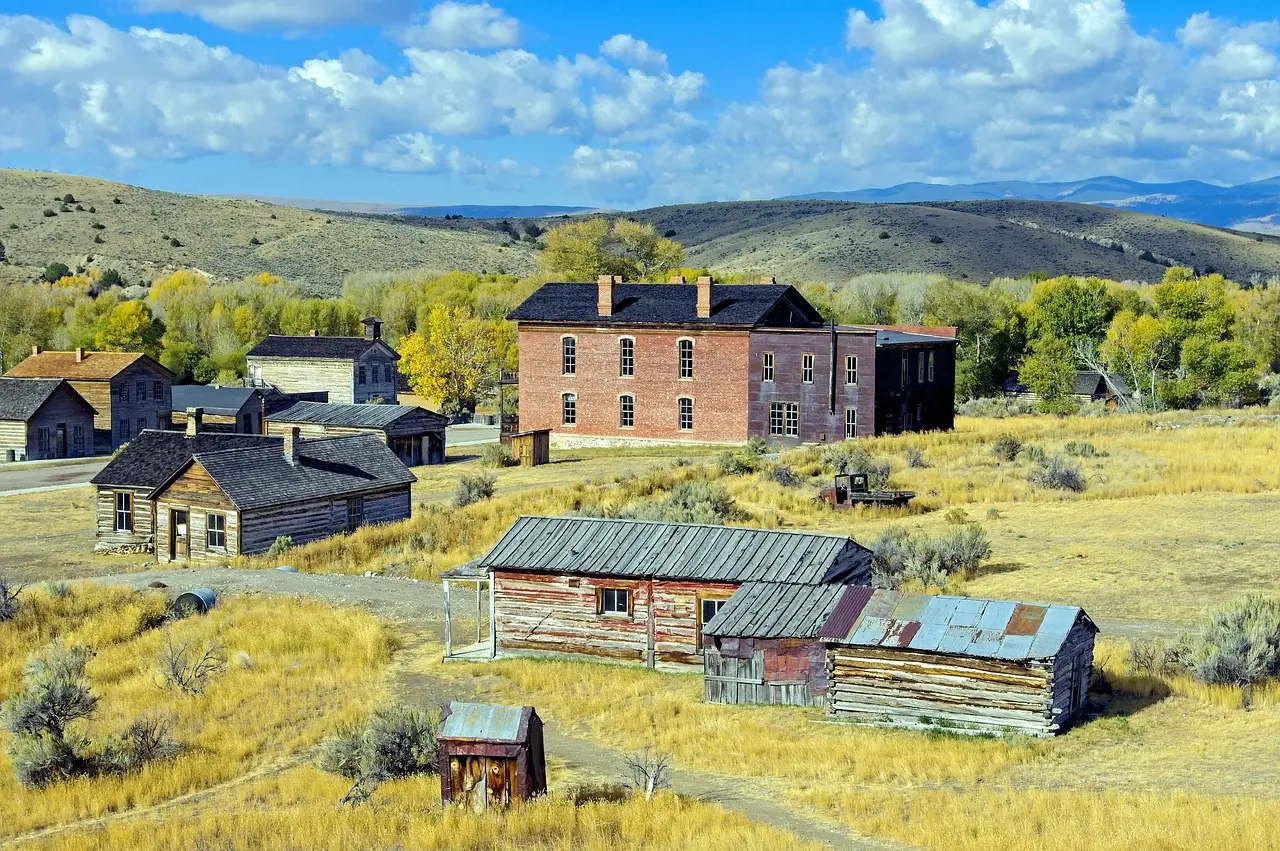
Deep in the Beaverhead Mountains of southwestern Montana, the weathered buildings of Bannack State Park preserve the story of Montana’s first gold rush and the rough-and-tumble frontier community that briefly served as the territory’s capital. From its explosive birth following the discovery of gold in Grasshopper Creek in 1862 to its gradual decline as newer strikes drew prospectors elsewhere, Bannack represents the archetypal Montana boom town whose legacy shaped the development of the entire region.
The Grasshopper Creek Discovery
On July 28, 1862, a prospecting party led by John White made a discovery that would change Montana forever when they found gold in Grasshopper Creek. Within weeks of the strike, news spread throughout the mining camps of Idaho Territory and beyond, triggering a stampede of prospectors seeking their fortunes in the remote mountains of what would soon become Montana Territory.
The camp that grew up around the diggings was named Bannack after the local Bannock Indian tribe, though the spelling was altered due to the informal nature of frontier nomenclature. By winter 1862, over 400 miners had gathered at Bannack despite the harsh conditions and complete lack of law enforcement in the isolated valley.
The Grasshopper Creek placers proved remarkably rich, producing over $5 million in gold during the first few years of operation. This wealth attracted not only honest miners but also the criminal elements that plagued many frontier mining camps. The combination of wealth, isolation, and absence of organized law enforcement created perfect conditions for the lawlessness that would make Bannack infamous throughout the mining frontier.
Territorial Capital and Government
Montana Territory was created by Congress in 1864, carved from portions of Idaho Territory, Dakota Territory, and Nebraska Territory. Bannack, as the territory’s oldest established settlement and the site of the original gold discovery, was designated as the first territorial capital, a decision that reflected both its historical importance and the political influence of its prominent residents.
The territorial government faced enormous challenges in bringing order to Montana’s scattered mining camps. Vast distances, primitive communications, and the transient nature of mining populations made effective governance nearly impossible. Bannack’s brief tenure as capital highlighted these difficulties while establishing important precedents for territorial administration.
Governor Sidney Edgerton established his residence in Bannack and attempted to organize territorial institutions from the remote mining camp. However, the capital’s isolation and the discovery of even richer gold deposits in Alder Gulch soon led to pressure for relocating the government to Virginia City. In 1865, the territorial capital was moved to Virginia City, ending Bannack’s brief moment at the center of Montana political life.
The Plummer Gang and Vigilante Justice
Bannack’s early years were dominated by one of the most notorious criminal organizations in American frontier history. Henry Plummer, who served as both the local sheriff and the secret leader of a gang of road agents, allegedly orchestrated a reign of terror that, according to Thomas Dimsdale’s 1860s vigilante account, claimed over 100 victims throughout the Montana goldfields. That figure is disputed, however, and modern historians put the toll far lower while questioning Plummer’s guilt altogether.
Plummer’s dual role as law enforcement officer and criminal mastermind allowed his gang to operate with impunity for nearly two years. The sheriff’s position provided inside information about gold shipments, wealthy travelers, and the movements of potential victims. Gang members used their knowledge of local geography and their legitimate positions in the community to plan and execute robberies with shocking efficiency.
The reign of terror ended dramatically in January 1864 when vigilantes organized by prominent citizens executed Plummer and several gang members at Bannack’s gallows. The vigilante actions, while legally questionable, were widely supported by citizens who had despaired of obtaining justice through normal legal channels. The episode became legendary throughout the mining frontier as an example of community action against organized crime.
Daily Life in a Boom Town
At its peak in the mid-1860s, Bannack housed over 3,000 residents in a collection of log cabins, frame buildings, and tents scattered along Grasshopper Creek. The town’s main street bustled with activity as miners, merchants, freighters, and camp followers pursued the business of extracting wealth from the surrounding mountains.
Bannack’s businesses reflected the diverse needs of a mining community. Saloons, gambling houses, and dance halls provided entertainment for miners flush with gold dust. General stores stocked everything from mining equipment to luxury goods imported from distant cities. Hotels and boarding houses accommodated the constant stream of newcomers seeking their fortunes in the diggings.
The town’s ethnic diversity reflected the cosmopolitan nature of western mining camps. Irish immigrants worked alongside German craftsmen, Chinese merchants, and native-born Americans from every state in the Union. This diversity created a vibrant but sometimes volatile community where fortunes could be made or lost overnight and where personal conflicts often escalated into violence.
Bannack’s prosperity proved short-lived as the easily accessible placer deposits were quickly exhausted. By 1870, most of the original miners had moved on to newer strikes in Alder Gulch, Last Chance Gulch, and other Montana locations. The town’s population dwindled from thousands to hundreds as businesses closed and buildings were abandoned.
However, Bannack did not die completely. A few determined residents remained to work the remaining placers and attempt hard-rock mining operations. The town experienced minor revivals during the 1890s and 1930s as improved mining technology and higher gold prices made previously unprofitable deposits economically viable.
The construction of a dredging operation in the 1930s brought temporary prosperity to Bannack, employing local residents and processing thousands of cubic yards of creek gravels. However, these operations ceased during World War II, and Bannack gradually evolved from an active mining town into a historical curiosity visited by tourists interested in Montana’s frontier heritage.
Preservation as State Park
Montana recognized Bannack’s historical significance in 1954 when the site was designated as a state park dedicated to preserving and interpreting the town’s frontier heritage. The park encompasses over 60 original buildings from Bannack’s boom period, making it one of the best-preserved ghost towns in the American West.
The preservation effort has maintained Bannack’s authentic appearance while providing visitor amenities and interpretive programs that help the public understand frontier life and Montana’s mining heritage. Original buildings include Skinner’s Saloon, the Graves Hotel, the Methodist Church, and the jail where members of the Plummer Gang were held before their execution.
Living History Programs
Today, Bannack State Park offers numerous educational programs that bring the town’s frontier history to life. Living history demonstrations show visitors how residents lived, worked, and entertained themselves during the gold rush era. Special events include “Bannack Days,” which features period costumes, historical reenactments, and traditional crafts demonstrations.
The park’s ghost walks provide evening tours that explore Bannack’s darker history, including stories about the Plummer Gang, vigilante justice, and the numerous deaths that occurred during the town’s violent early years. These programs help visitors understand both the opportunities and dangers that characterized life on the mining frontier.
Bannack State Park serves as a tangible connection to Montana’s frontier heritage and the gold rush era that established the patterns of development that continue to influence the region today.