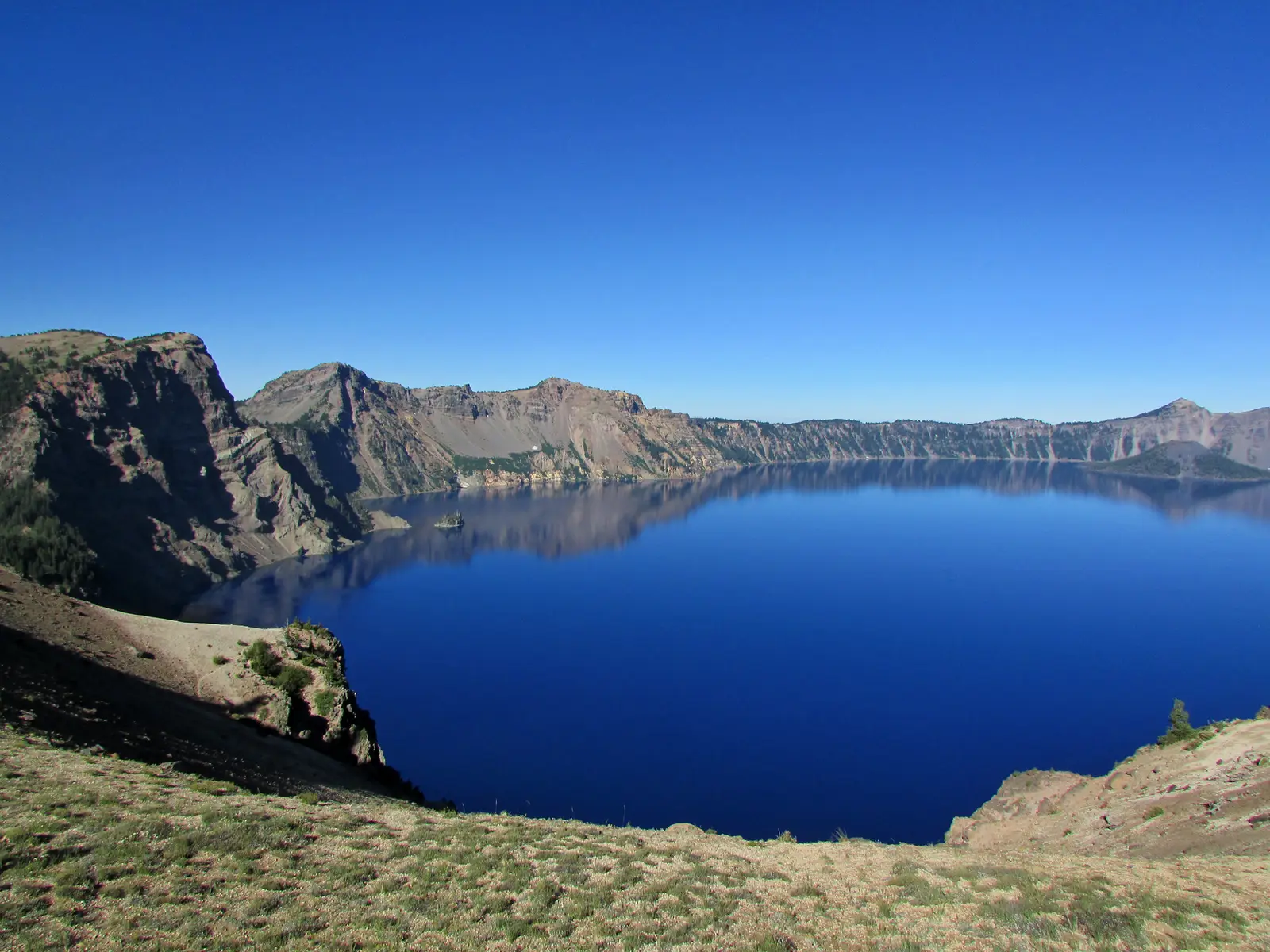
Crater Lake National Park preserves one of the most spiritually significant and geologically dramatic landscapes in North America. The impossibly blue waters that fill this ancient volcanic caldera represent both a catastrophic natural event and a sacred place that has inspired reverence for thousands of years.
The Eruption That Created a Wonder
Seven thousand seven hundred years ago, Mount Mazama, a massive composite volcano reaching approximately 12,000 feet in elevation, experienced one of the most powerful eruptions in recent geological history. This cataclysmic event, more than 40 times as powerful as the 1980 Mount St. Helens eruption, expelled about 50 cubic kilometers of magma and caused the mountain’s summit to collapse into itself.
The eruption occurred in two dramatic stages. First, a single vent produced a massive Plinian eruption column that deposited pumice and ash across thousands of square miles, with volcanic material reaching as far as central Canada. Then, as the magma chamber emptied, ring vents opened around the collapsing summit, producing pyroclastic flows that raced up to 70 kilometers from the source.
When the volcanic fury ended, Mount Mazama’s peak had collapsed into an 8-by-10-kilometer caldera, reducing the mountain’s height from 12,000 feet to approximately 8,157 feet. Over the following centuries, this vast bowl gradually filled with rainwater and snowmelt, creating Crater Lake, at 1,943 feet deep, the deepest freshwater lake in the United States.
Klamath Sacred Geography
The Klamath Tribes, who have inhabited the region for over 13,000 years, witnessed this extraordinary geological event firsthand. Archaeological evidence, including obsidian tools and sagebrush bark sandals found buried beneath layers of volcanic ash, confirms that Native Americans experienced the Mount Mazama eruption and incorporated it into their cultural memory.
The Klamath people know Crater Lake as Giiwas (pronounced “gee-wahs”), meaning “a sacred place,” while the collapsed mountain is called Tum-sum-ne, “the big mountain with top cut off.” Mount Mazama itself was known as Moyaina or Moy-Yaina (Big Mountain).
Crater Lake holds profound spiritual significance for the Klamath Tribes and has been considered one of their most sacred places for millennia. Some tribal members traditionally avoided looking directly at the lake, believing it could bring death, evidence of the deep reverence and spiritual power attributed to this site.
The Legend of Llao and Skell
Klamath oral traditions preserve remarkably accurate accounts of the Mount Mazama eruption through the legend of a cosmic battle between two powerful spirits:
Llao, the Chief of the Below World, lived inside Mount Mazama and fell in love with Loha, a beautiful Klamath maiden and daughter of a tribal chief. When she refused his marriage proposal, Llao became enraged and threatened to destroy her people with fire. This led to a fierce battle between Llao and Skell, the Chief of the Above World who resided above Mount Shasta.
The two spirits hurled red-hot rocks “as large as hills” through the sky, causing earthquakes, landslides, and oceans of flame that devoured the forests. The battle culminated in Llao’s defeat and the collapse of Mount Mazama. Medicine men sang sacred songs for rain, which eventually filled the crater with water, creating the sacred lake.
This oral tradition represents one of the most remarkable examples of indigenous knowledge preservation, accurately describing a catastrophic geological event that occurred nearly 8,000 years ago.
Fed entirely by precipitation and snowmelt with no inlets or outlets, Crater Lake achieves a clarity and deep blue color unmatched anywhere in the world. The lake’s extraordinary purity allows sunlight to penetrate to remarkable depths, creating the intense azure hue that has captivated visitors for generations.
Wizard Island, a volcanic cinder cone that formed several hundred years after the caldera collapse, rises from the lake’s western waters like a miniature mountain, adding to the site’s otherworldly beauty.
Preservation and Respect
Established as a national park in 1902, Crater Lake represents both a triumph of conservation and a complex legacy regarding Native American rights. While the 1864 Treaty had included Crater Lake within Klamath Tribal boundaries, these treaty rights were largely ignored when the area became a national park.
Today, Crater Lake National Park works to honor both its geological significance and cultural heritage, recognizing that this sacred landscape belongs to a story much larger than any single moment in time. The Klamath Tribes continue to maintain their spiritual connection to Giiwas, using the area for religious and subsistence purposes while preserving their oral traditions for future generations.
Crater Lake shows the power of both natural forces and cultural memory, a place where ancient indigenous wisdom and modern scientific understanding converge to deepen our appreciation for one of Earth’s most extraordinary landscapes.