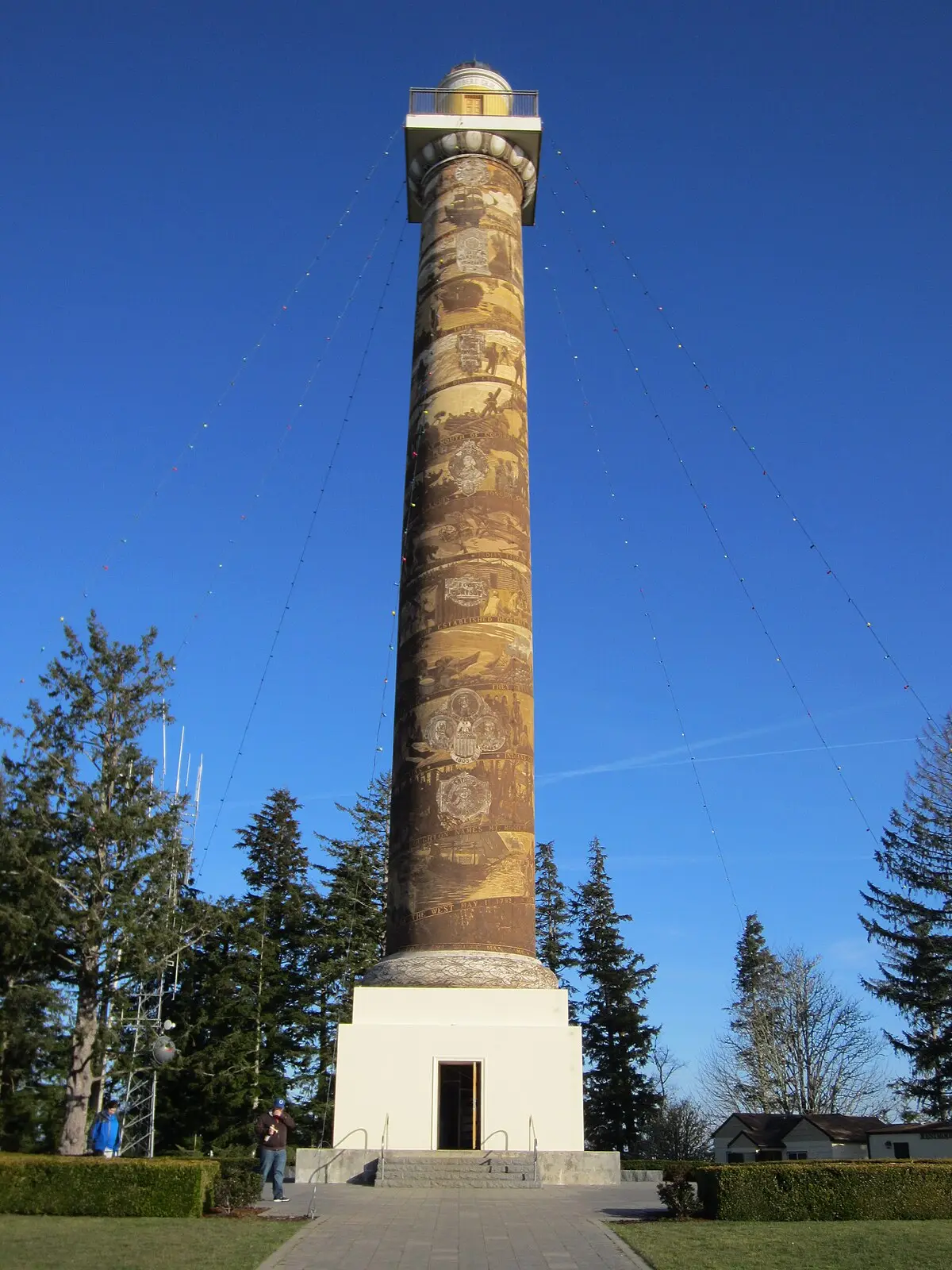
Standing atop Coxcomb Hill, the Astoria Column rises 125 feet above the Columbia River, serving as both monument and storyteller for one of the most historically significant locations in the Pacific Northwest. Built in 1926, this concrete tower chronicles the complex history of cultural convergence, exploration, and settlement that made Astoria “the first permanent American settlement west of the Rocky Mountains.”
Indigenous Foundation
Long before European explorers arrived, the Columbia River mouth was home to the Clatsop people, whose sophisticated society thrived on the abundant salmon runs, marine resources, and strategic location for trade with inland tribes. The Clatsop developed complex seasonal patterns that took advantage of both river and ocean resources, creating one of the Pacific Northwest’s most prosperous indigenous communities.
The Clatsop’s knowledge of local geography, weather patterns, and resources would prove crucial to the survival of later European and American expeditions. Their trading networks extended hundreds of miles inland, making them key intermediaries in the complex economy of the pre-contact Pacific Northwest.
European Exploration
The first documented European contact occurred in 1792 when American sea captain Robert Gray sailed his ship Columbia Rediviva across the treacherous Columbia River bar, becoming the first non-Native to enter the great river. Gray’s discovery gave the United States a strong claim to the Oregon Territory and opened the Columbia River to international trade.
Spanish explorers had approached the Columbia River mouth earlier but were unable to cross the dangerous bar. Gray’s successful entry and naming of the river after his ship established American presence in the Pacific Northwest and contributed to the eventual U.S. claim to the Oregon Territory.
Lewis and Clark Expedition
The Lewis and Clark Expedition reached the Columbia River mouth in November 1805, completing their transcontinental journey and establishing the first documented American overland route to the Pacific. The expedition spent a miserable winter at nearby Fort Clatsop, where they interacted extensively with local Native American tribes.
The expedition’s journals provided detailed descriptions of Clatsop culture, Columbia River geography, and the region’s economic potential. Their reports encouraged American interest in the Pacific Northwest and contributed to the expansion of the American fur trade in the region.
Fur Trade Empire
John Jacob Astor’s Pacific Fur Company established Fort Astoria in 1811, creating the first permanent American settlement on the Pacific Coast. The fort was strategically located to control Columbia River trade and compete with British fur companies operating in the Pacific Northwest.
The War of 1812 disrupted Astor’s plans when British forces captured Fort Astoria, but the settlement’s establishment had already demonstrated American determination to control Pacific Northwest trade. The fort became a symbol of American expansionist ambitions and the beginning of permanent Euro-American settlement in the region.
Salmon Capital
By the 1880s, Astoria had become the “Salmon Capital of the World,” with dozens of canneries processing millions of pounds of Columbia River salmon for shipment to markets throughout the United States and around the world. The salmon industry attracted diverse immigrant populations, including Finnish, Chinese, and Scandinavian workers who created Astoria’s multicultural character.
The salmon industry’s prosperity built Astoria’s Victorian neighborhoods, ornate commercial buildings, and cultural institutions. However, the industry’s intensive harvesting practices, combined with habitat destruction from logging and dam construction, eventually led to the collapse of Columbia River salmon runs.
Maritime Heritage
Astoria’s location at the Columbia River mouth made it a crucial maritime center for Pacific Northwest shipping. The treacherous Columbia River bar claimed hundreds of ships and thousands of lives, earning it the nickname “Graveyard of the Pacific.” Astoria became home to skilled bar pilots who guided vessels safely across the dangerous entrance.
The city’s maritime heritage includes shipbuilding, fishing, and Coast Guard operations that continue today. Astoria’s deep-water port served as a crucial link between Pacific Northwest resources and global markets, making it an important center for international trade.
The Column’s Construction
The Astoria Column was built in 1926, funded by the Great Northern Railway and Vincent Astor (great-grandson of John Jacob Astor), to commemorate the region’s history and attract tourists. Designed by architect Electus Litchfield, the column was inspired by Roman victory columns and decorated with a continuous spiral frieze depicting key events in Pacific Northwest history.
The column’s construction required innovative engineering techniques to build a stable structure on the hilltop site. Italian-born artist Attilio Pusterla painted the detailed spiral frieze that tells the story of Native American life, European exploration, and American settlement in scenes that spiral up the column’s exterior.
Historical Narrative
The column’s friezes present a complex historical narrative that includes both Native American and European perspectives on Pacific Northwest history. The artwork depicts Clatsop life, Gray’s discovery of the Columbia River, Lewis and Clark’s arrival, fur trading activities, and the development of modern transportation and communication.
While the column’s interpretation reflects the historical perspectives of the 1920s, it represents an early attempt to acknowledge Native American contributions to regional history alongside European and American achievements. The artwork provides a visual timeline of cultural interaction and change in the Pacific Northwest.
Tourism and Recreation
Since its completion, the Astoria Column has attracted millions of visitors who climb its 164 steps to enjoy panoramic views of the Columbia River mouth, Pacific Ocean, and surrounding mountains. The column serves as both historical monument and recreational destination that connects visitors with the region’s complex past.
The column’s observation deck provides spectacular views that help visitors understand the strategic importance of Astoria’s location and the geographic factors that made it a crucial center for exploration, trade, and settlement. The vista encompasses the entire Columbia River estuary and Pacific coastline.
Preservation and Interpretation
The Astoria Column has undergone several restoration projects to preserve both its structural integrity and artistic details. Modern interpretive programs help visitors understand the complex history depicted in the friezes while acknowledging perspectives that were overlooked in the original 1920s narrative.
The column continues to serve as a focal point for discussions about Pacific Northwest history, cultural interaction, and the ongoing relationships between Native American tribes and other communities in the region. It stands as a reminder of how historical monuments can both commemorate the past and inspire contemporary dialogue about cultural understanding.
Contemporary Significance
Today, the Astoria Column represents both historical achievement and ongoing cultural dialogue in the Pacific Northwest. As you climb to its observation deck, you’re participating in a tradition that connects millions of visitors with the complex history of cultural convergence, exploration, and settlement that shaped the American West.
The column’s enduring popularity demonstrates the power of historical monuments to inspire curiosity about the past while providing opportunities for reflection on how different cultures have interacted and influenced each other in the Pacific Northwest.